
A missed customer call can become a missed opportunity. A phone system that fails during an internet outage can stop scheduling, sales, support, and dispatch work just as quickly. That is why the VoIP versus PBX decision should not start with a feature list or the lowest monthly quote. It should start with how your people work, what downtime would cost, and who is accountable when communications need attention.
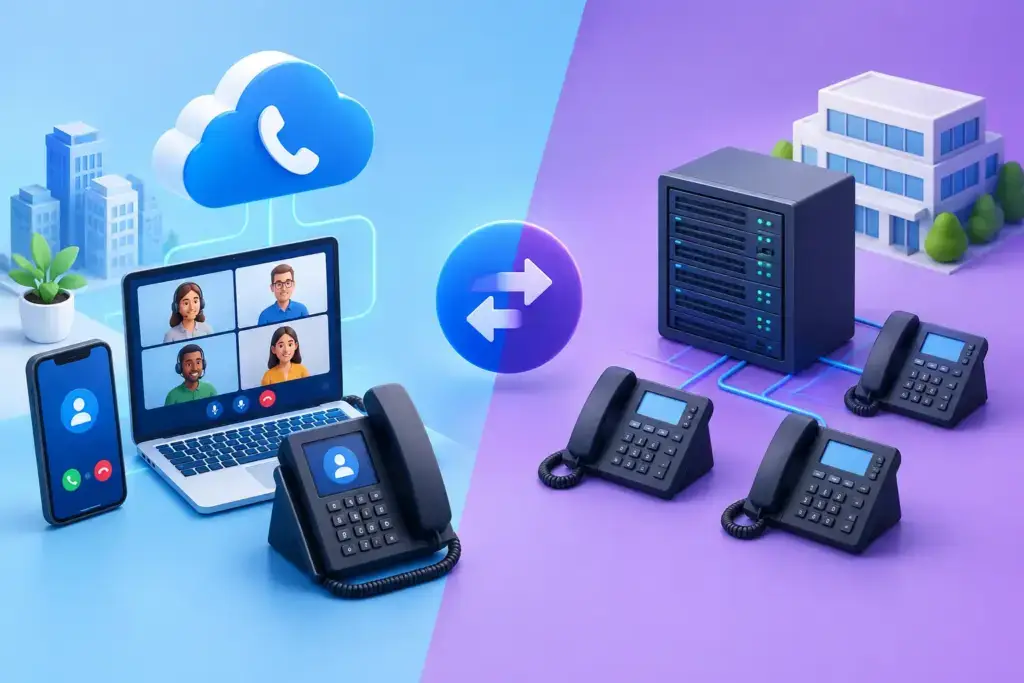
There is also a common source of confusion: VoIP and PBX are not always competing technologies. VoIP describes how voice calls travel, typically over an internet connection. PBX describes the system that routes calls, extensions, voicemail, call queues, and other business phone functions. A PBX can use traditional phone lines, VoIP, or a mix of both.
For many small and mid-sized businesses, the practical choice is between a cloud-hosted VoIP phone system and an on-premises PBX. Each can be the right answer. The better fit depends on operational priorities, risk tolerance, existing infrastructure, and plans for growth.
VoIP versus PBX: Understand the Real Difference
A traditional on-premises PBX places the phone system hardware in your office, server room, or data closet. Your organization owns or leases the equipment and is responsible for maintaining it, configuring it, and planning for replacement. Calls may run through local phone circuits, SIP trunks, or other services connected to that hardware.
Cloud VoIP moves most of that phone system infrastructure to a provider’s data centers. Users make and receive calls through desk phones, desktop applications, mobile apps, or headsets. The system is managed through an online administration portal, and adding a new employee usually means assigning a license and configuring a device rather than installing another physical phone line.
The distinction matters because it shifts responsibility. With an on-premises PBX, your business has more direct control over the equipment but also more direct responsibility. With hosted VoIP, the provider manages the core platform, while your business still needs dependable internet, secure user access, properly configured networks, and support that understands your environment.
When Hosted VoIP Is Usually the Better Fit
Hosted VoIP is often the practical choice for businesses with hybrid employees, multiple locations, or changing headcounts. A receptionist can answer a main business number from the office, while a sales representative can take the next call from a laptop or mobile app. Call routing can follow business hours, departments, on-call schedules, or location rules without requiring someone to rewire a phone closet.
Scalability is another advantage. A growing business does not need to make a large hardware purchase every time it adds employees or opens a new office. Costs are generally subscription-based and easier to forecast monthly. For organizations that want capital available for growth, security improvements, or other priorities, that model can be attractive.
VoIP can also centralize communications. Features such as auto attendants, call queues, voicemail-to-email, recording, text messaging, and reporting can be available in one system. The actual feature set varies by platform, so decision-makers should focus on the workflows their teams need rather than paying for a long list of capabilities no one will use.
Hosted VoIP is not automatically hands-off, however. Voice quality depends on the network. If guest Wi-Fi, video meetings, cloud backups, and phones all compete for limited bandwidth, callers may experience delays, dropped audio, or choppy conversations. A sound implementation includes bandwidth planning, network segmentation, quality-of-service settings where appropriate, and ongoing monitoring.
When an On-Premises PBX Still Makes Sense
An on-premises PBX can remain a sensible option for organizations with specialized phone requirements, an established technical team, or a need for highly customized call handling. Some businesses have already invested significantly in compatible hardware and may have valid reasons to keep it in service during a planned transition.
It can also offer more local control. If internal extension calling is essential during an internet disruption, an on-site system may preserve certain functions even when external calling is affected. Businesses with strict operational environments sometimes prefer that degree of direct ownership.
But ownership brings lifecycle obligations. Hardware eventually reaches end of life. Software needs updates. Configuration knowledge can become concentrated in one employee or one outside vendor. If that person is unavailable during an outage, the phone system becomes another source of uncertainty rather than a dependable business tool.
The upfront economics deserve a clear review as well. An on-premises PBX may look less expensive over time, particularly for a stable organization with a long planning horizon. Yet the full cost includes servers or appliances, licensing, implementation, circuit costs, maintenance, backups, replacement parts, power protection, cooling, and expert support. The purchase price alone is not the total cost of ownership.
Reliability Is About More Than the Phone Platform
A cloud phone system can be highly reliable, but your local internet connection is part of the service. If your office loses connectivity and employees cannot use mobile data or work from another location, they may not be able to place or receive calls as usual. The same is true for many cloud applications, which is why communications planning should be part of broader business continuity planning.
The right response is not necessarily to reject VoIP. It is to plan for failure. A business can use a secondary internet connection, automatic call forwarding, mobile applications, battery backup for network equipment, and documented outage procedures. For some organizations, retaining a backup analog line or cellular option may also be justified.
An on-premises PBX has its own dependencies. A local power event, hardware failure, carrier outage, or damaged circuit can still interrupt service. The question is not which option can never fail. No system can make that promise. The question is how quickly your business can keep communicating when a component does fail.
Security and Compliance Belong in the Conversation
Business phone systems are a frequent target for fraud. Threat actors may attempt to compromise administrator accounts, reroute calls, misuse international dialing, impersonate executives, or exploit poorly protected voicemail. A phone system is part of your attack surface, not a separate convenience tool.
For either model, require multi-factor authentication for administrative access, use strong unique credentials, limit international calling when it is not needed, and review call activity for unexpected patterns. Access should match job responsibilities. Former employees should lose access promptly, including mobile app sessions and voicemail access.
If calls include sensitive client information, recordings and voicemail also require attention. Ask where data is stored, how long it is retained, who can access it, and whether those controls align with your contractual, regulatory, or cyber insurance obligations. Compliance does not mean choosing the most expensive platform. It means selecting one with controls that fit the information your business handles.
Make the Decision Based on Business Operations
Before comparing vendors, document what your phone system must do on an ordinary workday and during a disruption. Consider call volume, after-hours coverage, remote work, office locations, CRM or help desk integrations, fax needs, paging systems, and the people who will administer the platform.
A 15-person professional office with remote staff may benefit from a straightforward hosted VoIP setup with mobile apps and an auto attendant. A multi-site service business may need call queues, location-based routing, recording policies, and backup connectivity. A facility with legacy intercoms, overhead paging, or specialized equipment may require a phased approach rather than an immediate replacement.
The best choice is rarely the platform with the most features. It is the one that supports productive work, remains defensible from a security standpoint, and has a clear owner for support, changes, and continuity planning.
For business leaders, the most useful question is not, “Should we choose VoIP or PBX?” Ask instead: “Can our communications system support the way we operate next year, and do we have a plan when it does not?” A qualified technology partner can turn that question into a practical roadmap, so your phone system becomes one less operational surprise.
