
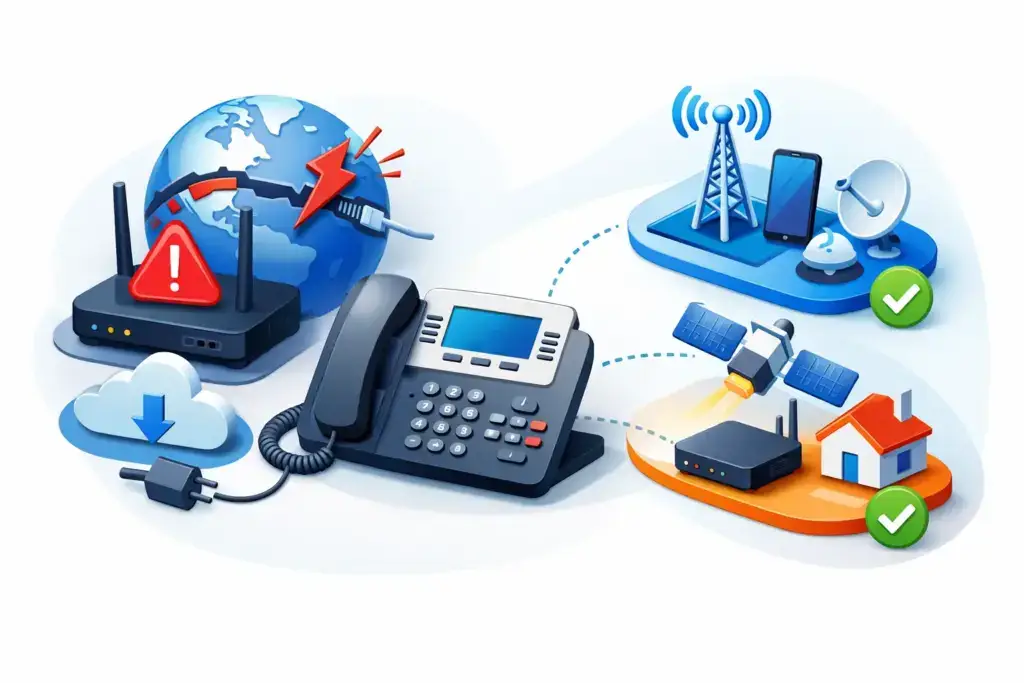
A dropped internet connection should not force your front desk, sales team, or service department into silence. Can VoIP support failover? Yes, but the answer depends on how your phone system, internet circuits, call routing, and staff procedures are designed before an outage happens.
For a small or mid-sized business, failover is not a phone feature you simply switch on and forget. It is a continuity plan for one of the most visible parts of your operation: how customers, vendors, and employees reach your business when something goes wrong.
Can VoIP Support Failover? Yes, With the Right Design
VoIP failover is the ability to reroute calls or restore calling capability when a primary connection, device, office, or provider path is unavailable. In a properly planned environment, callers may be sent to employee mobile phones, a backup site, another office, voicemail, an answering service, or a temporary call queue.
Cloud-hosted VoIP systems are generally better positioned for this than traditional on-premises phone systems. The call control platform lives in the provider’s environment rather than only inside your office. If your office loses internet access, incoming calls can still reach the hosted platform and follow an alternate routing rule.
That distinction matters. Your office phones may stop working during a local internet outage, but the business phone number does not have to stop receiving calls. A caller can be redirected to a mobile device or another location without knowing there is a problem.
There are limits. If the VoIP provider has a major outage, if number porting or routing was configured incorrectly, or if employees cannot access the devices designated for backup, failover may not deliver the customer experience you expected. The goal is not to promise that every event will be invisible. The goal is to prevent a localized technical issue from becoming a business interruption.
What VoIP Failover Can Cover
The strongest plans address more than one failure point. Internet failure gets the most attention, but it is only one scenario.
Internet circuit outage
A construction cut, ISP equipment issue, modem failure, or misconfigured firewall can take down an office connection. With cloud VoIP and preconfigured call forwarding, inbound calls can route to mobile phones, another office, or a staffed backup destination. For teams that must continue answering from the office, a secondary internet circuit or cellular backup can keep desk phones and softphone applications online.
Office outage
Power loss, flooding, fire alarms, or a building access issue may make the entire location unavailable. In this case, forwarding calls is only part of the plan. Employees need an approved way to work elsewhere, access business applications securely, and identify themselves consistently when answering calls.
A cloud phone platform gives the organization more options because staff can use a softphone on a managed laptop or mobile device from another location. That flexibility should still be governed by security controls, mobile device policies, and clear expectations for call handling.
Device or local network failure
Sometimes the internet is working but phones cannot register because of a switch failure, power-over-Ethernet issue, DHCP problem, or firewall change. A secondary connection path through a softphone application can give critical users a way to make and receive calls while IT isolates the local problem.
Provider or carrier disruption
No provider is immune to an upstream issue. A mature design considers whether the business can forward key numbers externally, use an alternate contact method, and communicate status quickly. For organizations with high call volume or regulated operations, this may justify more advanced carrier diversity or a dedicated contact-center contingency plan.
The Difference Between Call Forwarding and True Continuity
Basic call forwarding is useful, but it is not the same as a full communications continuity plan. Forwarding the main number to an owner’s cell phone may keep a few urgent calls from being missed. It can also create a bottleneck, leave customers without the right department, and make reporting nearly impossible.
True continuity preserves the structure of how calls are handled. For example, a caller choosing “billing” should still reach the billing backup group, while a service emergency should follow its normal escalation path. The team answering calls should see the business caller ID when calling back, not expose personal mobile numbers, and have access to the information needed to help the caller.
This is where planning becomes operational rather than technical. Decide which departments need coverage first, who owns each backup group, how after-hours calls should work, and when callers should hear a temporary outage message. A five-person office may need a simple mobile ring group. A 150-person organization may need department-level routing, supervisor visibility, call queue overflow rules, and documented communications for employees.
Build a Failover Plan Around Business Priorities
The right design starts with the cost of missed calls. A medical office, law firm, field service company, property manager, and sales-driven business do not all have the same definition of an acceptable interruption.
Start by identifying your critical phone numbers and call flows. This includes the main line, sales lines, support numbers, emergency or on-call numbers, fax services that still support workflows, and any published direct-dial numbers for executives or departments. Then determine what should happen if the office is offline for 15 minutes, two hours, or a full day.
For each critical call flow, establish a primary and secondary destination. The primary might be a softphone group of available employees. The secondary could be an answering service, another location, or a designated management group. Avoid routing every call to one individual unless that person has explicitly accepted the responsibility and has a viable backup.
Your plan should also account for these practical requirements:
- A secondary internet path, such as a second ISP circuit or managed cellular failover, for locations where staff must remain operational onsite.
- Battery backup for modems, firewalls, network switches, and Wi-Fi equipment, because an internet backup is of little use if local network equipment loses power immediately.
- Mobile or desktop softphone access for designated employees, with multi-factor authentication and managed devices where appropriate.
- Current call routing documentation, including emergency changes, provider support contacts, ownership of the account, and authorization procedures.
- A clear method for outbound calling, so employees can return customer calls using the company identity rather than personal numbers.
Do Not Overlook 911 and Call Quality
Emergency calling is one of the most overlooked VoIP failover details. When employees work from home, a temporary site, or a mobile device, the emergency location associated with their extension may no longer match where they physically are. Your organization should understand how its platform handles E911, location updates, and emergency notifications.
Call quality is another trade-off. Cellular backup can keep calls moving, but it may not support every employee handling high-volume calls, video meetings, cloud applications, and file transfers at the same time. A backup connection must be sized for the services that truly need to operate during an outage. Prioritizing voice traffic on the network can help, but it cannot create bandwidth that is not there.
There is also a cost decision. Dual internet circuits, cellular data plans, battery systems, and more sophisticated routing add expense. For many businesses, that investment is justified only for critical roles and locations. The most effective approach is to align the design with downtime tolerance rather than buying complexity for its own sake.
Test VoIP Failover Before You Need It
A failover plan that has never been tested is an assumption. Phone numbers change, employees leave, mobile applications are signed out, and a well-intended routing rule can send calls to the wrong place.
Test your plan at least annually and after material changes to your phone system, internet service, office layout, or staffing structure. A useful test includes simulating loss of the primary internet connection, placing calls to main and department numbers, confirming queue and voicemail behavior, verifying outbound caller ID, and checking that the designated employees can answer securely from their alternate devices.
Keep the test focused on business outcomes. Did a customer reach a person? Did the right department receive the call? Could the employee return the call from the company number? Did leadership know what was happening and who owned the response? Those answers matter more than whether every technical alert appeared exactly as expected.
For businesses with multiple vendors, testing also exposes accountability gaps. One provider may manage the internet circuit, another the firewall, and another the phones. During an outage, that fragmentation can turn a straightforward routing change into a long chain of support tickets. A strategic technology partner helps coordinate the full path, from network connectivity to phone configuration and staff communication.
A Better Standard for Phone Reliability
VoIP can support failover effectively when it is treated as part of business continuity, not just as a replacement for desk phones. The best design gives your team defined options, protects customer access, and makes the next outage a managed event rather than a scramble.
Before the next internet interruption tests your organization without warning, identify the calls you cannot afford to miss and make sure there is a real person, device, and routing path ready to receive them.