
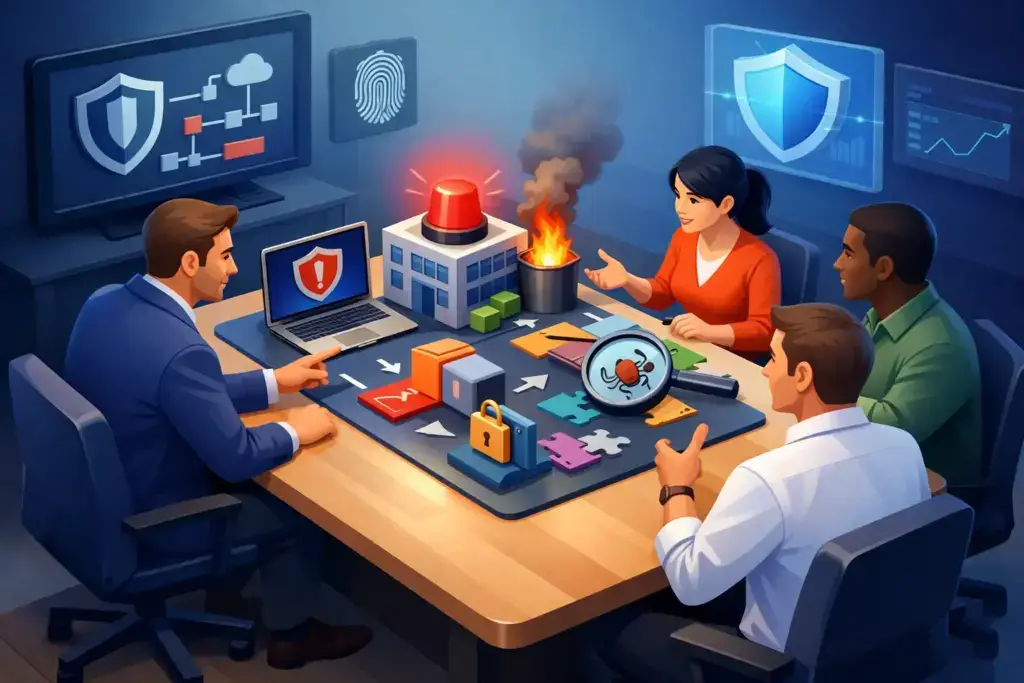
A ransomware alert rarely arrives at a convenient time. It may start with an employee reporting a locked file, a vendor warning that suspicious emails came from your domain, or a bank asking about an unusual payment request. In that first hour, the business does not need a perfect technical explanation. It needs people who know who decides, who communicates, and what happens next. That is what an incident response tabletop guide is designed to test.
A tabletop exercise is a structured conversation built around a realistic security scenario. It does not shut down systems or simulate an actual attack. Instead, leaders, IT staff, and key business stakeholders walk through decisions while the stakes are low. The goal is to find confusion before it turns a manageable incident into downtime, financial loss, or reputational damage.
For small and mid-sized businesses, this exercise is especially valuable. Most do not have a large internal security team waiting in a command center. They rely on a mix of internal administrators, business leaders, outside IT partners, insurance contacts, and department managers. A tabletop reveals whether those pieces can work as one response team when pressure is real.
What a Tabletop Exercise Should Accomplish
A useful exercise is not a quiz on cybersecurity terminology. It should answer operational questions: Can we recognize an incident quickly? Who has authority to isolate a device or take a cloud service offline? How will employees, customers, vendors, and regulators be informed if necessary? Can we restore critical systems in an order that keeps the business moving?
The exercise should also expose reasonable trade-offs. Isolating a server may interrupt a revenue-producing application, but leaving it connected could increase the scope of an attack. Sending a company-wide message quickly may reduce rumor and confusion, but an inaccurate message can create legal and customer-service problems. Your team should practice making these calls with the right people in the room.
A tabletop is not proof that an organization will never suffer an incident. It is evidence that the organization has thought through its response, assigned ownership, and identified gaps that need investment. That preparation supports resilience, compliance expectations, and cyber insurance discussions.
Build Your Incident Response Tabletop Guide Around Reality
Generic ransomware scenarios have value, but the best exercise reflects how your business actually operates. Start with the systems and processes that would create the greatest disruption if they were unavailable or compromised. For a professional services firm, that may be Microsoft 365, client records, file sharing, and billing. For a manufacturer, it could include production systems, remote access, inventory, and vendor communications. For a healthcare or financial services organization, protected information and notification obligations should shape the scenario.
Choose one scenario for each exercise. Trying to cover ransomware, business email compromise, data theft, and a cloud outage in one meeting usually leads to broad discussion and few actionable decisions. A focused scenario creates clearer lessons.
Good starting scenarios include:
- A payroll employee receives a convincing email and approves a fraudulent change to direct-deposit information.
- Endpoint security detects encryption activity on a file server used by multiple departments.
- A compromised Microsoft 365 account sends phishing messages internally and to customers.
- A departing employee downloads a large volume of sensitive files to a personal cloud account.
- A critical vendor reports a breach that may affect credentials or customer data shared with your organization.
Add details in stages. Begin with the initial report, then introduce new information every 10 to 15 minutes. For example, the team learns that the affected user has administrative access, backups may be connected, a customer has called about suspicious emails, or a news outlet has requested comment. These prompts show how decisions change as facts emerge.
Put the Right People at the Table
The right group is usually smaller than leaders expect. Include the executive who can make business-impact decisions, the person responsible for IT or the managed IT partner, an operations representative, and the owners of finance, HR, legal, or communications when those functions are relevant. If your organization handles regulated data, include the compliance lead as well.
Every participant should understand their role before the exercise begins. One person coordinates the response. One person leads technical containment and investigation. One leader approves business decisions such as pausing a service or notifying customers. Another person maintains the incident log, capturing what was known, what was decided, and when.
Do not assume titles equal responsibilities. A CEO may be the final decision-maker but should not be expected to direct forensic work. An office manager may know exactly how to reach every employee after hours but may not have authority to speak to customers. Clear role assignments prevent a common failure during incidents: several people acting at once while nobody owns the next decision.
Your managed security or IT provider should be part of the exercise if that provider will be part of the real response. This is where businesses often find a gap between an assumed service and an actual commitment. Confirm who monitors alerts, who can isolate devices, who contacts outside forensics, how after-hours escalation works, and which actions require written approval.
Run the Exercise Like a Business Decision Meeting
Set aside 60 to 90 minutes. Share only the exercise objective and basic rules in advance. Participants should know this is a no-fault discussion, not a performance review. The facilitator presents the initial scenario, asks what each person would do, and records decisions, assumptions, and unanswered questions.
Ask direct questions. How was the event reported? What evidence would confirm it is a security incident rather than a technical failure? Who can authorize taking a system offline? What systems must be preserved for investigation? Can the business continue manually for four hours, one day, or one week? Who contacts cyber insurance counsel, law enforcement, customers, or affected vendors?
Keep the conversation grounded in time. “We would notify employees” is incomplete. The better question is who drafts the message, who approves it, what it says, and when it goes out. “We would restore from backup” also needs detail: Which backup is clean, who validates it, how long restoration takes, and whether recovery meets the business’s acceptable downtime.
The facilitator should challenge assumptions without turning the session into a technical interrogation. If someone says, “Our backups are covered,” ask when they were last tested and whether the team can restore the most critical system within the recovery target. If the answer is uncertain, that is a productive result.
Measure the Gaps That Matter
The value of the exercise is in what happens afterward. Within a few days, turn notes into an action register with an owner, priority, due date, and expected outcome. Avoid vague follow-ups such as “improve security awareness.” Instead, define actions that can be verified: update the incident contact list, test restoration of a critical application, require phishing-resistant multifactor authentication for administrators, or document the approval process for customer notifications.
Prioritize gaps by business impact and likelihood. A missing after-hours contact list may be simple to fix and highly consequential. A network redesign may take longer and require budget planning. Both belong on the roadmap, but they should not be treated as equal urgency.
This is also the right time to review the documents and tools that support incident response. Confirm that asset inventories are current, administrator accounts are known, backup locations are documented, vendor contacts are accessible without relying on a compromised email account, and cyber insurance information is available to the response team. A plan stored only in the system you may lose is not much of a plan.
How Often Should You Test?
Most small and mid-sized businesses should run a tabletop exercise at least annually. Higher-risk organizations, businesses with compliance requirements, or companies undergoing major change may benefit from twice-yearly exercises. Run an additional exercise after a meaningful event, such as a merger, new cloud platform, leadership change, major vendor transition, or actual security incident.
Rotate scenarios over time. One session may focus on ransomware and recovery. The next may test business email compromise, where the main challenge is stopping fraud and managing communications rather than restoring systems. The point is not to memorize a script. It is to build decision-making muscle across the risks that could interrupt your business.
A mature response plan is not a binder that sits untouched until a crisis. It is a living operating process, tested by the people who will use it. When an incident forces difficult choices, the calmest organizations are usually not the ones with the most paperwork. They are the ones that have already practiced how to move from uncertainty to action.
