
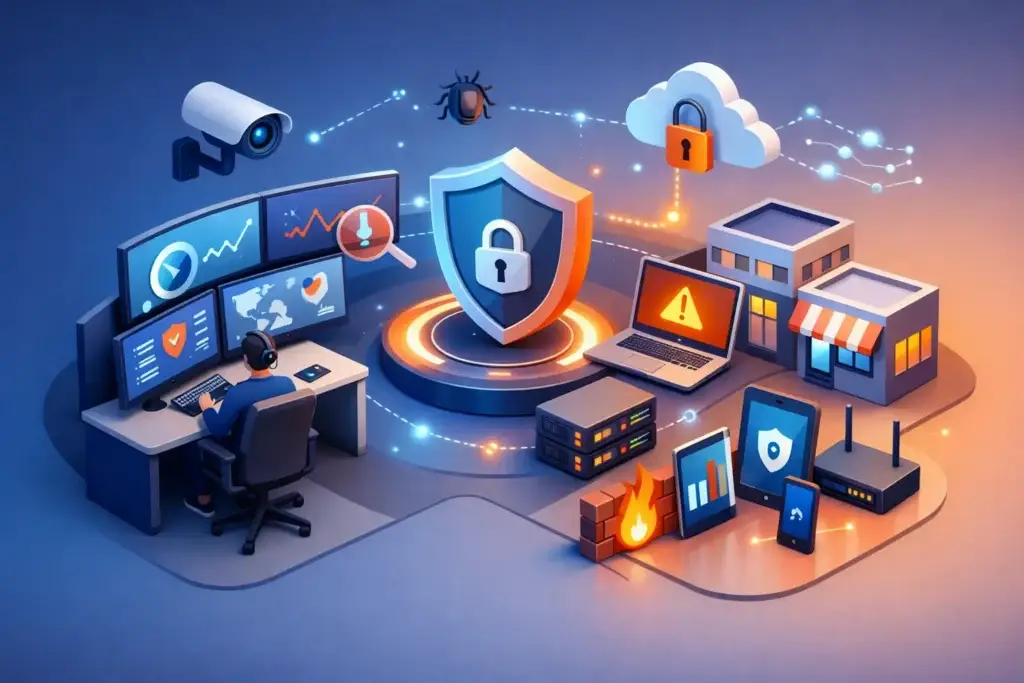
A ransomware alert at 2:13 a.m. does not care that your company has 38 employees, one overstretched IT generalist, and a cyber insurance renewal due next month. That is exactly why SOC monitoring for SMBs has become a business decision, not just a security upgrade.
For smaller organizations, the real problem is rarely a lack of tools. It is the gap between having security products and having someone actively interpret, investigate, and respond to what those products are saying. Firewalls, endpoint protection, Microsoft 365 alerts, and cloud logs can generate a lot of noise. Without a team watching, correlating, and escalating what matters, critical signals get buried until the issue becomes downtime, data loss, or a painful client conversation.
Why SOC monitoring for SMBs is different
Large enterprises can justify an internal security operations center because they have the budget, staffing depth, and attack surface to support it. Most SMBs do not. They need meaningful coverage without hiring several analysts, buying a stack of enterprise tools, and building round-the-clock workflows from scratch.
That changes what good looks like. For an SMB, effective SOC monitoring is not about copying a Fortune 500 model. It is about getting the essentials right. Threats need to be detected quickly, false alarms need to be filtered out, and real incidents need a clear response path tied to the business. If a user account is compromised, the question is not just whether an alert fired. The question is whether someone validated the threat, contained it, and helped leadership understand impact and next steps.
This is also where many SMBs get stuck between extremes. On one side, they have reactive IT support that can fix issues after the fact but is not equipped to monitor and investigate threats continuously. On the other side, they hear enterprise security messaging that sounds expensive, complex, and disconnected from day-to-day operations. The right SOC model lives in the middle. It should be disciplined, practical, and aligned with actual business risk.
What a SOC is really doing behind the scenes
A security operations center is not a room full of blinking screens for dramatic effect. At its best, it is a coordinated function that collects signals from your environment, analyzes suspicious activity, triages incidents, and drives response.
For SMBs, that usually includes monitoring endpoints, identity systems, email, cloud platforms, firewalls, and sometimes backup, network, or compliance-related events. But technology is only one part of it. The bigger value comes from correlation and judgment. A failed login by itself may mean nothing. That same failed login followed by a successful login from an unusual location, mailbox rule changes, and mass file access is a different story.
That context is what turns raw alerts into usable action. It also reduces alert fatigue, which is one of the fastest ways for smaller teams to stop trusting their own security stack.
Detection is only half the job
Many SMBs assume they are covered because they receive alerts from endpoint software or a firewall. Alerts are useful, but they are not the same as monitoring. Detection tells you that something may be wrong. Monitoring means someone is reviewing, validating, prioritizing, and deciding what happens next.
That distinction matters when minutes count. If suspicious PowerShell activity triggers an alert on a Friday night, someone has to determine whether it is normal administration, a false positive, or an active threat. If it is malicious, someone needs authority and process to isolate the device, disable the account, or escalate immediately. Without that layer, your business is effectively depending on chance and inbox visibility.
The business case for SOC monitoring
Security buyers are often told to think in terms of threats, but leadership teams usually make decisions based on operational risk. That is the better lens.
SOC monitoring helps reduce the chance that a security issue becomes a prolonged outage. It improves visibility when insurance questionnaires ask about continuous monitoring and response. It supports compliance programs that expect log review, incident handling, and documented oversight. It also gives internal teams breathing room. Your office manager, operations lead, or solo IT person should not be the overnight escalation path for every suspicious login.
There is a financial argument too, although it is not always obvious at first. A managed SOC service often costs far less than one serious business interruption, one wire fraud incident, one failed audit finding, or one month of executive distraction after a preventable breach. Smaller companies tend to feel those disruptions harder because they have less redundancy in staff, systems, and customer tolerance.
What SMBs should expect from a SOC partner
Not every SOC offering is the same, and the differences matter. Some providers mostly forward alerts. Others investigate and guide response. The strongest partners tie security monitoring into broader IT operations so incidents can be contained quickly instead of getting lost between vendors.
A good SOC service for an SMB should provide 24/7 monitoring, but that alone is not enough. You also want clear escalation paths, defined severity levels, meaningful reporting, and visibility into what is being watched. If your team cannot explain who responds, how response decisions are made, and what happens after an incident, the service is probably thinner than it sounds.
You should also ask how the SOC handles tuning. Every environment generates normal activity that can look suspicious on paper. If the monitoring team does not refine rules over time, you get too much noise or too many missed signals. SMBs benefit most from monitoring that learns their environment, business hours, common applications, and risk priorities.
Integration matters more than extra tools
This is where vendor sprawl becomes a real security problem. If one company handles IT support, another handles endpoint software, another manages the firewall, and another sends monthly security reports, incident response gets slow fast. Everyone owns part of the picture, and no one owns the outcome.
A more effective model is integrated oversight. When the team monitoring your environment also understands your user base, cloud setup, device inventory, backup posture, and business priorities, decisions happen faster and with less confusion. That is one reason many growing businesses work with an MSP and MSSP partner rather than trying to coordinate multiple specialists independently.
Common mistakes SMBs make
The first mistake is assuming size equals safety. Attackers target smaller businesses because defenses are often lighter and recovery is harder. The second is buying tools without a monitoring plan. Security products can create a false sense of maturity when no one is actively working the alerts.
A third mistake is treating SOC monitoring as separate from business continuity. If an incident occurs, the response intersects with operations immediately. Who approves account lockouts? Which systems are mission-critical? How do you communicate with staff if email is affected? Monitoring is stronger when those operational decisions have already been discussed.
Another issue is expecting perfect prevention. No security program can promise that nothing bad will happen. The more realistic goal is early detection, fast containment, and clear decision-making. That is often what separates a manageable incident from a headline-level disruption.
Is SOC monitoring worth it for every SMB?
It depends on risk, complexity, and consequences. A 12-person professional services firm with cloud apps, client data, and cyber insurance requirements may have a stronger case for SOC monitoring than a similarly sized business with minimal digital exposure. A multi-location company with remote users, Microsoft 365, industry compliance obligations, and no internal security staff almost certainly does.
The question to ask is not, “Are we big enough?” It is, “What happens if we miss an active threat for six hours, overnight, or over a long weekend?” If that answer includes lost revenue, client impact, regulatory trouble, or major internal disruption, the case becomes much clearer.
For many organizations, the right first step is not building a formal security department. It is putting expert eyes on the systems they already rely on and creating an accountable path for response. That is the practical value of SOC monitoring for SMBs. It brings maturity without forcing a small business to operate like a giant one.
For companies trying to grow without adding more uncertainty, that kind of visibility is not overkill. It is how you keep one bad night from turning into a very expensive quarter.
