
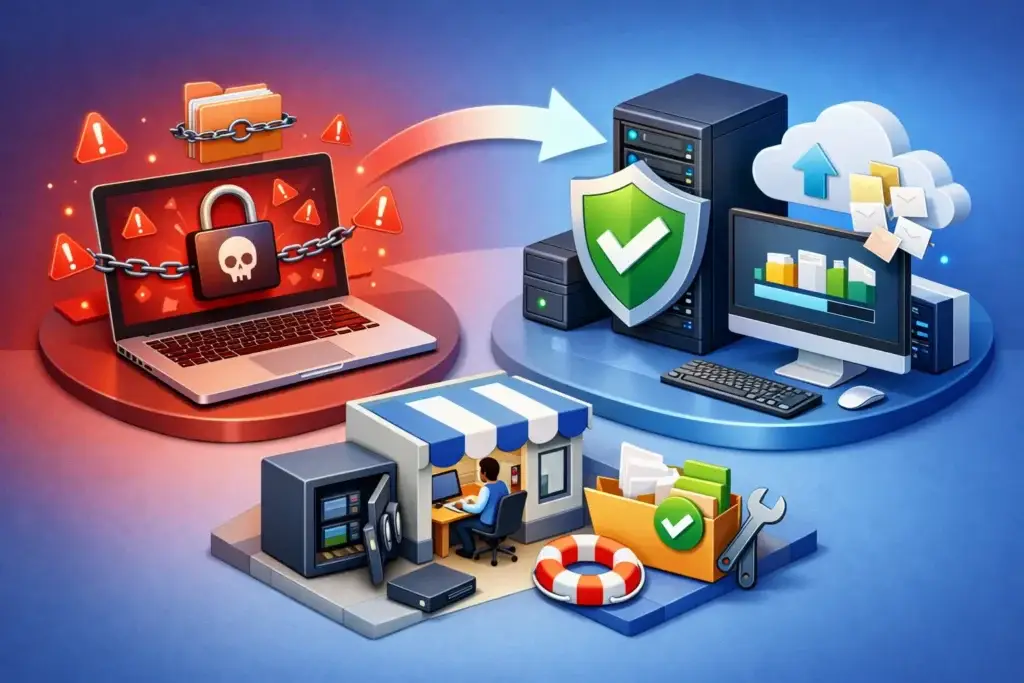
At 8:12 on a Tuesday morning, a 22-person company opened for business and found shared files renamed, accounting locked, and a ransom note on every workstation. That kind of small business ransomware recovery example matters because it shows the real cost of weak preparation – and just as importantly, what a disciplined recovery process looks like when leadership stays calm.
For small and mid-sized businesses, ransomware is rarely just an IT event. It becomes an operations problem, a finance problem, a customer communication problem, and sometimes a legal and insurance problem within the same hour. The businesses that recover fastest are not always the ones with the biggest budgets. They are usually the ones with clear decisions, tested backups, and a partner who can coordinate technical response with business priorities.
A small business ransomware recovery example from the real world
Consider a regional professional services firm with one main office, a few remote employees, Microsoft 365, a line-of-business accounting platform, and a local file server. Like many growing companies, they had pieced together technology over time. Their email security was decent, endpoint protection was basic, and backups existed, but no one had recently tested whether those backups could restore systems under pressure.
The intrusion likely began with a phishing email that captured credentials from a manager who also had elevated access. From there, the attacker moved through remote access tools, disabled some protections, and encrypted the most business-critical data overnight. By morning, the company could not invoice clients, access contracts, or use several shared templates the team needed to operate.
The first mistake would have been to keep clicking around and hoping a few reboots would solve it. Instead, the company shut down affected machines, disconnected the server from the network, and contacted its IT and security response team immediately. That single decision limited lateral spread and preserved evidence that helped identify what had happened.
What happened in the first 24 hours
The first day of recovery was not glamorous. It was controlled triage.
The response team started by answering four questions. What systems were encrypted? Was the attacker still active? Were backups intact? What business functions had to come back first? Those questions sound simple, but they keep a company from wasting hours restoring low-priority systems while payroll, finance, or customer operations stay down.
Leadership designated one internal point person so technical updates and business decisions moved through a single channel. That matters more than many owners realize. In ransomware events, confusion becomes its own risk. If accounting is talking to cyber insurance, operations is talking to staff, and an outside vendor is restoring systems without coordination, the recovery slows down and errors multiply.
In this case, the team found three critical facts quickly. First, the ransomware had reached the file server and several endpoints but had not fully encrypted Microsoft 365 data. Second, backup storage had not been encrypted because it was segmented from the production environment. Third, the attacker had used compromised credentials, which meant password resets and identity containment had to happen before broad restoration began.
That changed the recovery plan. The company did not need to rebuild everything at once. It needed to secure identities, confirm clean restore points, and bring back the systems that drove revenue and client service.
The decision about paying the ransom
Business owners often ask the same question right away: should we pay?
In this example, the company did not pay. That was possible because recoverable backups existed and the data loss window was acceptable. If the only usable backup had been months old, the conversation would have been harder. This is where straight talk matters. There is no universal answer. Some organizations face severe operational or regulatory pressure and make a different choice. But paying is never a clean fix. There is no guarantee of a working decryptor, no guarantee stolen data will be deleted, and no guarantee the attacker will not come back.
The better path is to build an environment where paying is unnecessary, not to assume a ransom can function as a backup strategy.
The actual recovery process
Recovery took place in phases, not all at once.
First, the team isolated affected devices and revoked compromised sessions. They reset passwords, enforced stronger sign-in controls, and reviewed administrative accounts. That step delayed some restoration work, but it prevented reinfection. This is a common trade-off in ransomware response. Moving too fast on restoration without confirming containment can put the business right back at the beginning.
Second, they validated backups before restoring anything. Not every backup is a good backup. Some complete successfully but contain corrupted data, incomplete application states, or restore points that are too old to support current operations. In this case, the most recent clean server backup was from 11:00 p.m. the night before the attack, which meant only a few hours of work were at risk.
Third, they restored the accounting environment and core shared data before less essential folders and archived files. That let finance resume invoicing and let staff access active job files by the second business day. Full file restoration continued in the background after the company had already resumed partial operations.
Fourth, they rebuilt several endpoints instead of trying to clean them individually. For small businesses, full rebuilds are often faster and safer than spending hours trying to prove a machine is trustworthy. That approach can feel disruptive in the moment, but it usually shortens the total recovery timeline.
By the end of day two, the company had email, cloud collaboration, accounting access, and core file shares back online. By the end of day four, most users were operating normally, with a handful of historical files still being restored and validated.
What worked and what failed
This small business ransomware recovery example is useful because the outcome was mixed – good enough to avoid catastrophe, but not smooth enough to call the company well prepared.
What worked was network segmentation, off-network backups, and decisive leadership. The business had enough separation between production systems and backup systems to avoid a total loss. It also had leaders willing to pause operations briefly instead of letting staff continue using infected machines.
What failed was access control maturity and testing discipline. A single compromised account with more access than necessary created a much larger blast radius. Backup jobs had been monitored, but restore testing had not been done routinely. The company was fortunate that recovery points were usable. Fortune is not a strategy.
The incident also exposed a business process issue rather than a pure technology issue. Critical documents lived in shared folders with inconsistent ownership and no clear data classification. During recovery, the team had to ask multiple department leads which files truly mattered first. That added avoidable delay. Good ransomware readiness is partly about knowing what data runs the business and who decides its priority when time is tight.
The lessons business leaders should take from it
Most companies do not need enterprise-scale security tooling to improve their odds. They need the fundamentals implemented consistently.
Start with identity security. Phishing-resistant sign-in controls, tighter admin rights, and regular access reviews can stop many ransomware events before they spread. Then look at backup design. The question is not whether you have backups. The question is whether you can restore specific systems, within a defined timeframe, from clean copies that an attacker cannot easily reach.
After that, focus on response readiness. Know who makes decisions, who contacts insurance and legal counsel, who talks to employees, and who owns vendor coordination. A small company can move quickly if those roles are clear. It can also lose a full day to uncertainty if they are not.
There is also a broader point here for growing organizations in markets like Southern California and Las Vegas, where lean teams often manage fast-moving operations. Many businesses have outgrown ad hoc IT, but they still treat cybersecurity as a set of products instead of a managed discipline. That gap shows up during incidents. Tools alone do not restore operations. Process, accountability, and planning do.
For companies working with a strategic IT and security partner, this is where the relationship should prove its value. The right partner does more than deploy software. It helps define recovery priorities, test backup assumptions, tighten identity controls, and align technical response with business continuity. That is the difference between a vendor who fixes machines and a team that protects the business.
Ransomware recovery is never painless. But it does not have to become a company-breaking event. The businesses that recover best are usually the ones that decide in advance what matters most, protect it properly, and rehearse the moment they hope never comes. If your current setup leaves too many of those answers uncertain, that uncertainty is the risk worth fixing now.
