
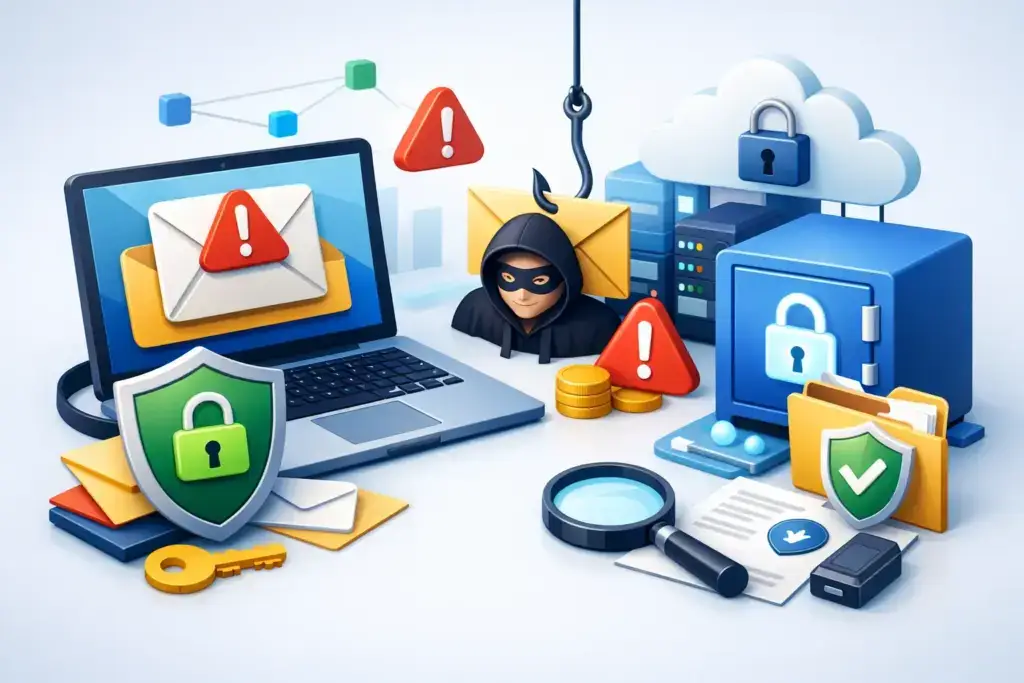
A finance employee receives an email from the CEO asking for an urgent wire transfer. The name looks right. The tone sounds familiar. The request arrives just before a vendor deadline, when questioning it feels like it could slow down the business.
That is exactly why business email compromise works. It does not usually depend on breaking through a firewall or deploying obvious malware. It exploits trust, timing, and ordinary business processes. To reduce business email compromise, your company needs more than employee reminders about phishing. You need controls that make a fraudulent request difficult to approve, even when it looks convincing.
Why business email compromise creates outsized damage
Business email compromise, often called BEC, is a form of social engineering in which criminals impersonate an executive, vendor, employee, or trusted partner to redirect money or gain access to sensitive information. In some cases, they compromise a real mailbox first and monitor conversations before striking. That gives them the details needed to send a request that feels legitimate.
For a small or mid-sized business, one successful wire fraud event can create more than a financial loss. It can disrupt vendor relationships, trigger insurance and compliance concerns, consume leadership attention, and expose weak approval processes that affect the whole operation. The recovery window is often short. Once funds move through multiple accounts, getting them back becomes far more difficult.
The hard truth is that a secure email platform alone will not stop every BEC attempt. Microsoft 365 and similar platforms provide valuable protections, but attackers adapt. A defensible approach combines identity security, financial process controls, ongoing monitoring, and a workforce that knows when to pause.
Reduce business email compromise with layered controls
The strongest BEC defenses do not ask one person or one technology to catch every threat. They build verification into the moments where fraud can cause harm.
Protect the identities attackers want most
Executive, finance, payroll, human resources, and accounts payable accounts deserve additional attention because they carry authority or access to sensitive processes. Start by requiring multifactor authentication for every user, then strengthen it for high-risk roles with phishing-resistant methods where practical.
Not all multifactor authentication provides equal protection. Text-message codes are better than passwords alone, but they can be vulnerable to interception and social engineering. Authenticator apps, number matching, hardware security keys, and conditional access policies create a stronger barrier. The right mix depends on your environment, workforce, and budget, but leaving privileged accounts protected by passwords alone is not a reasonable risk.
Access should also match each employee’s actual role. Remove former employees quickly, limit administrative privileges, and review shared mailboxes and delegated access. Attackers often use a compromised account to create hidden inbox rules that forward invoices or payment conversations outside the company. Regular reviews of forwarding rules, mailbox permissions, and unusual sign-in activity can reveal a problem before a payment is sent.
Make payment changes hard to approve by email alone
The most effective BEC control is often procedural, not technical: never accept a new bank account, changed payment instruction, or urgent wire request based on email alone.
Create a written verification process for vendor banking changes and payment requests above a defined dollar amount. Require an employee to call a known phone number already on file, not a number provided in the email. For larger transfers, require dual approval from two authorized people who verify the request independently.
This can feel slower than simply replying to an email. That is the trade-off. But a short verification step is far less disruptive than losing a six-figure payment. Good processes are designed to protect productivity without creating unnecessary friction. For example, a finance team can define clear thresholds, approved contacts, and escalation paths so employees know exactly what to do when a request is urgent.
Executive leadership must follow the same rules. If leaders occasionally bypass approval controls because a request is time-sensitive, employees learn that policy is optional. Consistency matters more than a polished policy document.
Block impersonation and risky email behavior
Email authentication standards such as SPF, DKIM, and DMARC help reduce the chance that criminals can send messages that appear to come from your domain. Properly configured, they give receiving email systems a way to validate legitimate mail and reject or quarantine unauthorized messages.
These controls require care. A rushed DMARC enforcement policy can interfere with legitimate third-party mail if your company has not identified all authorized senders. Start with visibility, review results, and move toward enforcement as your email ecosystem is validated. This is a practical example of why cybersecurity should be managed as an ongoing program rather than a one-time project.
Your email security settings should also flag impersonation attempts, suspicious attachments, lookalike domains, and unusual external senders. Disable automatic external forwarding unless there is a documented business need. Attackers use forwarding rules to quietly monitor conversations and wait for the right opportunity.
Monitor for the signals people miss
A BEC incident may begin with a sign-in from an unfamiliar location, repeated failed login attempts, a new mailbox rule, or a sudden change to a vendor payment conversation. No single alert proves fraud, but the pattern can matter.
That is where continuous monitoring and a defined response process add value. Someone needs clear responsibility for investigating alerts, disabling compromised sessions, resetting credentials, reviewing mailbox activity, and contacting the bank or affected vendors if fraud is suspected. Small businesses often have capable internal administrators, but they may not have the time or security specialization to watch for these signals consistently.
A managed security partner can provide coverage, escalation discipline, and regular security reviews without requiring a full internal security operations team. The goal is not to create more alerts. It is to turn meaningful signals into timely action.
Train for decisions, not just phishing tests
Annual security training is rarely enough. BEC attacks succeed because they create pressure: an executive seems unavailable, a vendor deadline is closing, or payroll needs to be updated immediately. Employees need permission to slow down when a request does not follow the normal process.
Useful training shows people what a realistic attack looks like in their role. Finance teams should practice vendor-change verification. Human resources teams should understand payroll diversion attempts. Executives and assistants should recognize impersonation patterns involving gift cards, wire transfers, and confidential documents.
Phishing simulations can help, but they should not become a gotcha exercise. If employees feel embarrassed for reporting a suspicious message, they will stay quiet. A stronger culture rewards reporting, treats questions as a sign of good judgment, and gives staff a simple path to escalate concerns.
Build BEC defense into your technology roadmap
Business email compromise is not solely an email issue. It touches identity management, cloud configuration, financial controls, incident response, insurance requirements, and leadership accountability. That makes it a useful test of whether your technology strategy is connected to how the business actually operates.
Start with a focused review: Which accounts can authorize payments? Which vendors can change banking details? Are multifactor authentication and access policies consistently enforced? Who reviews mailbox forwarding rules? If a payment request looks suspicious, who makes the call and who contacts the bank?
The answers should be documented, tested, and revisited as your team, vendors, and systems change. For organizations in Las Vegas and Southern California that have outgrown reactive IT support, this is the kind of risk that benefits from a named team, clear ownership, and a practical roadmap rather than another disconnected security tool.
A suspicious email will eventually reach someone in your organization. The goal is not to expect perfect judgment under pressure. The goal is to ensure that one convincing message cannot move money, change payroll, or expose critical information without a second layer of verification.