
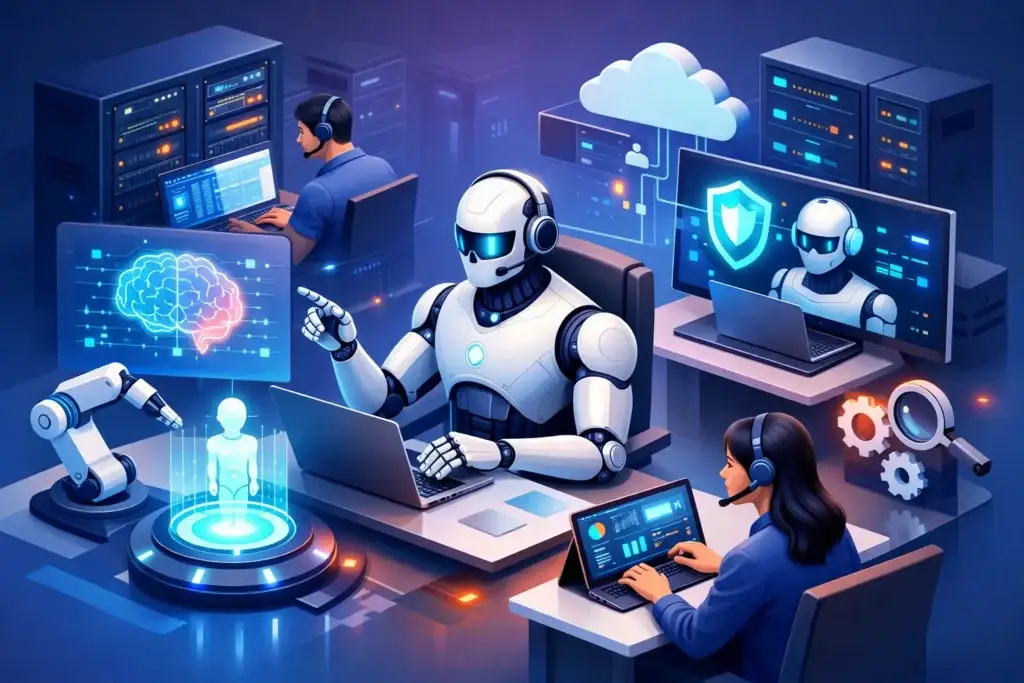
A ticket that keeps reopening, an employee locked out before a client call, or a suspicious login at 2:00 a.m. can all feel like isolated IT problems. They are often signals of a larger issue: your technology environment is producing more data, alerts, and dependencies than a small internal team can reasonably manage. AI in managed IT services is changing that equation, but not by replacing the people responsible for your systems. Its real value is helping the right people see patterns sooner, prioritize correctly, and act with better context.
For small and mid-sized businesses, that distinction matters. AI can make support and security more proactive, but it cannot own your business risk, understand an unusual operational requirement without context, or make an executive decision about priorities. The strongest results come from pairing AI capabilities with an accountable managed IT and security team that knows your environment.
Where AI in Managed IT Services Delivers Value
Managed IT has always involved monitoring, maintenance, support, and planning. AI adds speed and pattern recognition to those functions. Instead of waiting for a server to fail or a user to report a slow application, intelligent monitoring can identify trends that suggest a problem is developing.
For example, AI-assisted tools can correlate events across endpoints, cloud applications, network devices, and identity systems. A single failed login may be ordinary. Repeated failed logins from an unfamiliar location, followed by unusual mailbox activity and an attempted privilege change, deserve immediate attention. The advantage is not simply more alerts. It is better signal from the noise.
This is especially useful for businesses that have outgrown reactive support but do not need, or cannot justify, a large in-house IT department. A managed partner can use AI to reduce repetitive analysis and direct skilled technicians toward the exceptions that need judgment. That can mean faster resolution for common issues and more focused investigation when something genuinely looks wrong.
Faster support without a faceless help desk
AI can help service teams categorize tickets, surface relevant documentation, identify recurring root causes, and suggest likely next steps. When used well, this shortens the time between a reported issue and a useful response.
That does not mean every employee should be sent to a chatbot. Some problems are straightforward: a password reset, a printer connection, or guidance on a Microsoft 365 setting. Others affect workflow, revenue, security, or a critical client relationship. Those situations require a technician who can ask the right questions, coordinate with vendors, and stay accountable through resolution.
The goal is not to remove the human relationship from support. It is to stop skilled people from spending their day hunting through disconnected logs or repeating the same manual checks. Your team should still know who to call when the issue is complex, urgent, or business-critical.
Earlier detection of security threats
Cybersecurity is one of the clearest use cases for AI-assisted managed services. Modern attacks move quickly, and the volume of security telemetry can overwhelm a business that relies on occasional manual review. AI can help identify anomalies in user behavior, device activity, email patterns, and network traffic that may indicate phishing, compromised credentials, malware, or unauthorized access.
However, detection is only one part of the job. An alert must be validated, investigated, contained when necessary, documented, and connected to the broader security plan. False positives are common. A travel-related login may look suspicious until someone confirms the employee is at a conference. A large file transfer may be expected during a legitimate project.
That is why AI should support a managed security operation, not substitute for one. Human analysts and technical leaders provide the context that determines whether an event is harmless, urgent, or part of a larger incident. They also make sure response actions do not disrupt the business unnecessarily.
The Business Case Is Better Decisions, Not Just Automation
Business leaders should be cautious of AI promises that focus only on labor savings. Lower effort on routine tasks is useful, but the larger opportunity is improved decision-making. A well-managed technology environment creates clearer visibility into recurring issues, security gaps, aging infrastructure, and capacity concerns before they become expensive surprises.
AI can help turn operational data into questions worth discussing: Which locations experience the most downtime? Are repeated support requests pointing to a training problem, an unreliable application, or an outdated device standard? Which user accounts have access that no longer matches their role? Where does the business have a single point of failure?
Those insights become valuable when they feed a technology roadmap. A recommendation to replace equipment, improve identity controls, or revise backup coverage should be tied to business impact, timing, cost, and risk. A dashboard alone cannot provide that strategic connection.
For organizations working toward compliance requirements or cyber insurance expectations, the same principle applies. AI may assist with evidence collection, control monitoring, and gap identification. It cannot certify that your policies are being followed, determine how a regulation applies to your business, or take responsibility for the final outcome. Compliance still requires ownership, process, and leadership.
What to Ask Before Adding AI to Your IT Environment
The right approach depends on your business model, data sensitivity, existing systems, and tolerance for automation. A professional services firm handling confidential client files will have different guardrails than a company using AI to streamline internal scheduling or marketing drafts.
Before approving new AI tools or enabling AI features inside software you already use, leadership should have clear answers to four questions:
- What business problem are we solving, and how will we measure whether it improves?
- What data will the tool access, store, or use for training?
- Who reviews the output before it affects customers, systems, or business decisions?
- What happens when the tool is wrong, unavailable, or used outside its intended purpose?
These questions prevent a common mistake: adopting AI because competitors are talking about it, then discovering later that no one defined governance, access controls, or acceptable use. AI projects should begin with a practical use case and a clear owner, not an open-ended experiment with sensitive company data.
A managed IT partner can help evaluate vendor claims, configure access controls, establish acceptable-use policies, and determine where automation is appropriate. For many businesses, the first win is not a customer-facing AI project. It is improving internal service delivery, security monitoring, documentation, or reporting while keeping human review in place.
The Risks That Need Human Oversight
AI systems can produce incorrect answers with complete confidence. They can reflect incomplete data, misunderstand context, and expose information if they are connected to the wrong sources or used without clear controls. In IT operations, a bad automated action can be more damaging than a delayed recommendation.
For that reason, high-impact activities should have defined approval paths. Changes to user permissions, financial systems, production infrastructure, backups, and security containment procedures deserve more than an automated suggestion. The stakes are too high to treat confidence scores as certainty.
There is also a vendor-management concern. Many business applications are adding AI capabilities quickly, often with changing terms, data-handling practices, and administrative settings. Someone needs to review what is enabled, who can use it, and whether company information is leaving approved systems. This is not a one-time configuration task. It should become part of ongoing technology governance.
Building an AI-Ready IT Strategy
An AI-ready business does not need to adopt every new tool. It needs a stable foundation: managed identities, secure devices, reliable backups, documented processes, sensible data access, and clear ownership. Without that foundation, AI can accelerate confusion as easily as it accelerates productivity.
Start by identifying the operational friction that costs your team the most time or introduces the most risk. Then evaluate whether AI can assist with detection, analysis, documentation, or routine work while preserving review and accountability. Measure results against real outcomes such as reduced repeat tickets, faster response to security events, less downtime, or better visibility for leadership.
Quantum Shield IT approaches AI as part of a broader technology and security roadmap, not as a standalone product. The question is never just whether a tool is impressive. It is whether it fits your systems, protects your data, supports your people, and moves the business forward.
The companies that benefit most from AI will not be the ones that automate the fastest. They will be the ones that choose carefully, set sensible guardrails, and keep experienced people responsible for the decisions that matter.
