
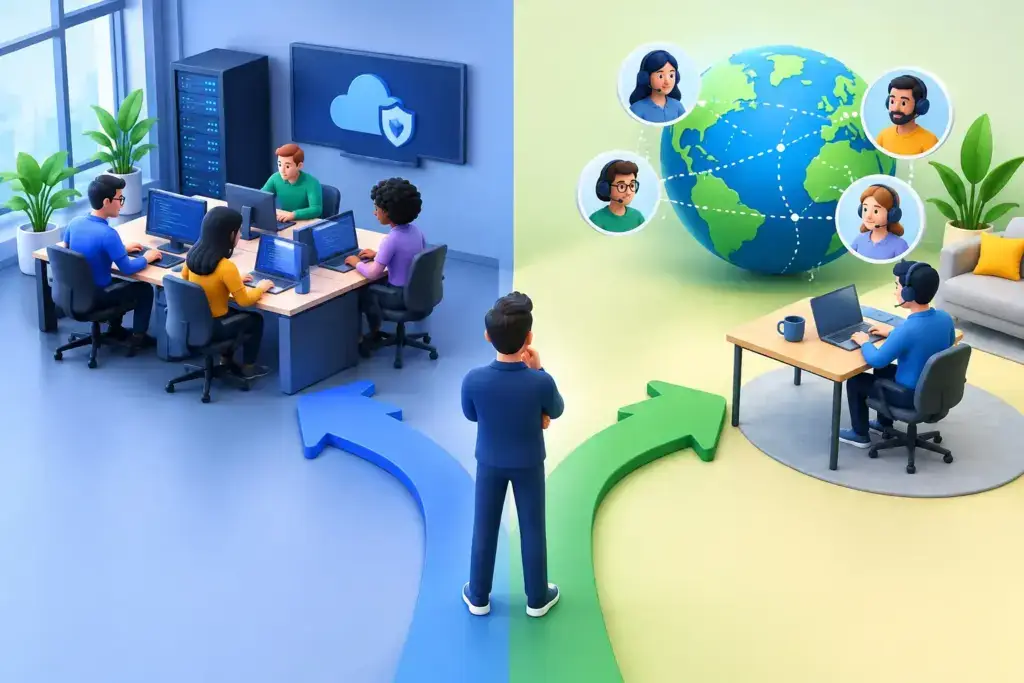
A single IT hire can feel like the obvious answer when tickets are piling up, employees are frustrated, and leadership needs someone accountable. But the decision is rarely as simple as hiring a technician or signing with a provider. In house versus outsourced IT is really a decision about coverage, risk ownership, strategic capacity, and how much technology your business needs to manage as it grows.
For a 25-person company, one capable internal IT professional may improve day-to-day support quickly. That same person cannot realistically be available around the clock, lead a security program, manage cloud architecture, prepare for compliance reviews, test disaster recovery, and plan the next two years of technology investments alone. The question is not whether internal or outsourced support is inherently better. It is whether your operating model gives the business the depth and accountability it needs.
In-House Versus Outsourced IT: Start With Business Needs
An in-house IT team gives your organization proximity. Internal staff know the people, workflows, equipment, and informal workarounds that keep the business moving. They can walk down the hall, see an issue firsthand, and build trust across departments. For businesses with highly specialized systems, complex physical sites, or frequent hands-on technology changes, that presence can be valuable.
The trade-off is concentration of risk. When one or two people hold the institutional knowledge, vacations, turnover, and competing priorities can expose gaps fast. An internal generalist may be excellent at helping users and maintaining systems while having limited time for security monitoring, vendor management, documentation, patch validation, or strategic planning. None of those responsibilities disappear because the team is small.
Outsourced IT, often delivered through a managed service provider, changes the model from relying on individual capacity to accessing a team with defined processes. Rather than hiring every specialty separately, a business can gain help desk support, infrastructure expertise, cybersecurity operations, Microsoft 365 administration, backup oversight, and executive guidance through one relationship.
That does not mean outsourcing should be treated as a way to hand off every technology decision. A quality provider should work alongside leadership and internal staff, not operate as a black box. The right relationship gives leaders more visibility into priorities, risks, budgets, and progress than they had before.
The Real Cost Is More Than Salary
Comparing a managed IT agreement to an employee’s salary creates a misleading picture. The fully loaded cost of internal IT includes benefits, payroll taxes, recruiting, training, retention, software tools, certifications, and the cost of coverage when that employee is unavailable. It also includes the hidden cost of unfinished work.
If internal staff spend most of their week resetting passwords, resolving printer issues, and responding to urgent requests, who is reviewing access controls, testing backups, updating the incident response plan, or documenting the network? These are not optional projects. They are operational safeguards that tend to become urgent only after a security event, failed recovery, or compliance request.
Outsourcing has its own cost considerations. A low monthly quote may exclude project work, after-hours support, security tools, onsite assistance, or strategic planning. It can also create frustration if the provider is slow to respond, unclear about scope, or constantly shifting responsibility to another vendor.
A better financial question is this: what level of support, security, and planning does the business need, and what would it cost to build that capability reliably? For many small and mid-sized organizations, outsourcing provides broader coverage at a more predictable monthly cost. For others, particularly those with large locations or specialized applications, a blended model makes more sense.
Calculate the Cost of Gaps
Downtime, compromised email accounts, failed backups, and delayed employee onboarding all have business costs. So does executive time spent coordinating internet providers, phone vendors, security products, and a break-fix technician who only appears after something fails.
A technology model should reduce those surprises. It should also make costs more visible before an emergency forces a rushed decision. Whether support is internal or outsourced, leaders should expect a documented technology roadmap, lifecycle planning, security priorities, and clear ownership for critical systems.
Security Changes the Decision
Cybersecurity is often the point where a simple staffing decision becomes a business risk decision. Threats do not operate on office hours, and security responsibilities are too broad to assign casually to the person who knows the most about computers.
A mature security program requires ongoing attention to endpoint protection, identity and access controls, email security, vulnerability management, backup integrity, employee awareness, incident response, and vendor risk. Depending on the industry, it may also require evidence for cyber insurance, customer questionnaires, HIPAA, PCI, CMMC, or other compliance expectations.
An internal IT manager can lead these efforts, especially when supported by the right tools and outside expertise. But expecting one person to handle security operations alongside every support request is a common source of exposure. Important work gets postponed because immediate business needs are louder.
An outsourced partner can provide a broader security bench, monitoring tools, policy guidance, and specialized resources when an incident occurs. The key word is can. Outsourcing does not automatically make an organization secure. Leadership should understand what is actually monitored, who responds to alerts, how quickly they respond, what security controls are included, and where responsibilities remain with the business.
Security accountability should be clear enough that no one has to ask, after an incident, who was supposed to own the issue.
When In-House IT Is the Better Fit
Building an internal team may be the right choice when your organization has a large employee base, complex proprietary applications, significant onsite infrastructure, or frequent operational changes that require daily physical presence. It can also fit businesses that need technology staff deeply embedded in production, logistics, engineering, or other specialized workflows.
Even then, internal teams often benefit from an outside partner. Specialized security monitoring, after-hours coverage, disaster recovery expertise, cloud projects, and vCIO or vCISO guidance can extend what the team can deliver without adding multiple full-time roles.
The strongest internal IT environments do not assume they must do everything themselves. They define what should stay close to the business and bring in outside depth where it improves resilience or speed.
When Outsourced IT Makes More Sense
Outsourced IT is usually a strong fit for organizations that need mature support and security but do not need, or cannot justify, a fully staffed internal department. This is common for businesses with 10 to 450 employees that are growing, supporting hybrid staff, opening locations, handling sensitive information, or trying to reduce vendor sprawl.
It also makes sense when leadership is tired of reactive support. If technology discussions only happen when the server fails, a key employee leaves, or an insurance application arrives, the business is operating without a plan. A strategic managed IT relationship should create regular planning conversations, measurable priorities, and a realistic path to improve the environment over time.
For organizations in Southern California or Las Vegas with multiple offices, warehouse space, retail locations, or a mix of onsite and remote users, the right provider can also coordinate infrastructure, communications, access control, cameras, cloud services, and security under one accountable team. That consolidation reduces the number of handoffs when something goes wrong.
The Hybrid Model Is Often the Practical Answer
The choice between internal and outsourced support is not always either-or. A hybrid model can preserve the business knowledge and immediate presence of an internal administrator while adding the scale of a managed IT and security team.
In this model, internal staff can focus on department relationships, specialized applications, and onsite priorities. The outsourced team can provide help desk capacity, cybersecurity monitoring, documentation standards, backup and recovery management, project support, and executive-level planning. Instead of competing for control, both sides work from a defined responsibility matrix.
This approach is especially useful when a capable internal IT employee is overwhelmed. The answer is not necessarily to replace that person. It may be to give them the coverage and expertise needed to move from constant firefighting into higher-value work.
Questions Leaders Should Ask Before Choosing
Before deciding, assess the technology model against four practical questions. Can the business support employees when they need help? Can it identify and respond to security issues quickly? Can it recover critical systems after a disruption? And can leadership see what technology investments are coming before they become emergencies?
If the answer to any of those questions is uncertain, the current model needs more than another tool or a one-time cleanup. It needs clearer ownership and a plan.
The best decision creates confidence without building unnecessary overhead. Choose the model that gives your people dependable support, gives leadership a clear view of risk, and gives the business room to grow without making technology a recurring source of surprises.
