
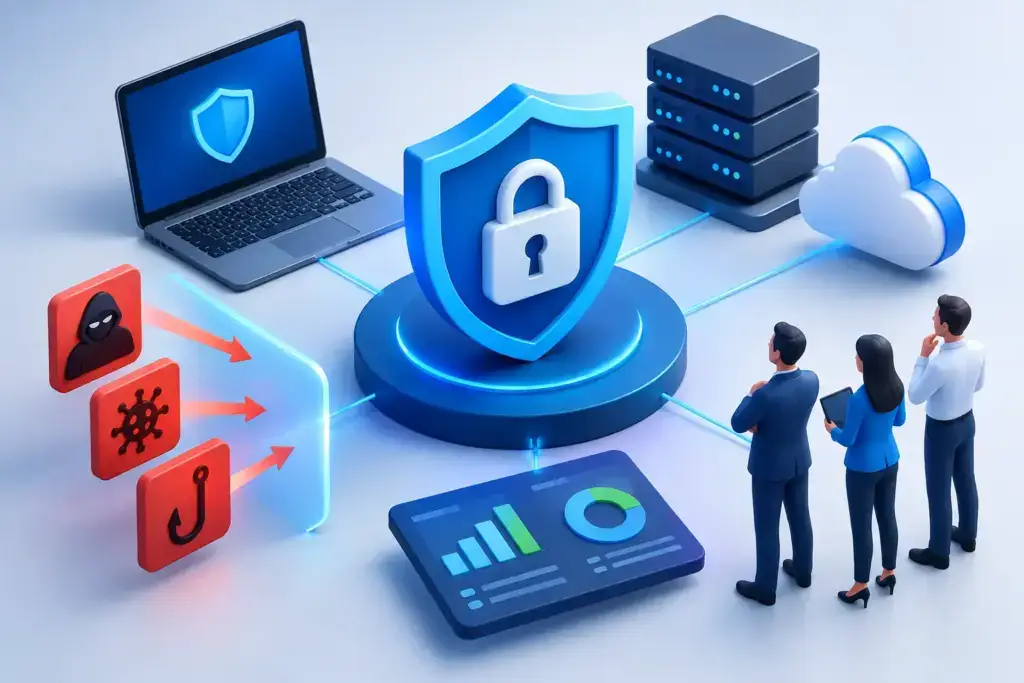
A growing number of security incidents do not begin with a dramatic network breach. They begin with a stolen Microsoft 365 login, an employee approving a convincing request, or a vendor account nobody remembered was still active. The cybersecurity trends shaping 2026 are making those ordinary gaps more expensive – and making reactive IT support less defensible for small and mid-sized businesses.
For leaders, the question is not whether every new security tool belongs in the budget. It is whether the business can identify its most likely points of failure, reduce them consistently, and recover without operational chaos. That requires ownership, visibility, and a plan that connects technical decisions to real business risk.
Cybersecurity Trends Are Shifting the Attack Surface
The modern attack surface is no longer limited to the office network. It includes cloud applications, employee devices, remote access tools, mobile phones, third-party vendors, connected cameras, VoIP platforms, and the identities used to access each of them. A business can have a well-configured firewall and still face serious exposure through a compromised email account.
This shift matters because attackers increasingly target the path of least resistance. Small businesses are attractive targets not because they are careless, but because many operate with limited internal IT staff, fragmented vendors, and systems that grew faster than their controls. An organization may have endpoint protection from one provider, backups from another, Microsoft 365 managed internally, and no one responsible for seeing the complete picture.
The answer is not to treat every system as equally critical. Start by mapping the systems that would stop revenue, payroll, customer service, or operations if they became unavailable. Then identify who can access them, how access is approved, and whether that access is reviewed when roles change. Security improves quickly when priorities are clear.
Identity Is Now the Primary Security Perimeter
Passwords alone are not a meaningful control for business-critical systems. Attackers buy stolen credentials, reuse passwords leaked from unrelated services, and use phishing pages that closely resemble legitimate sign-in screens. Even strong passwords can be defeated when an employee is persuaded to hand over a session token or approve a fraudulent multifactor prompt.
Multifactor authentication remains essential, but the quality of the method matters. Text-message codes are better than passwords alone, yet app-based authentication, number matching, and phishing-resistant methods such as security keys offer stronger protection for higher-risk accounts. Administrators, finance teams, executives, and anyone with access to sensitive records should receive the highest level of protection first.
Identity security also requires discipline after an employee is hired. Businesses need a reliable process for adding access, changing access, and removing access. When an employee leaves, an account that remains active is not an administrative oversight. It is an open door with an unknown keyholder.
The practical focus: fewer privileged accounts
Many businesses grant administrator rights because it is convenient in the moment. Over time, those exceptions become permanent. Limiting privileged access, using separate administrative accounts, and reviewing permissions on a routine schedule can significantly reduce the damage a compromised account can cause.
There is a trade-off: tighter access controls can create friction if they are rolled out without planning. The goal is not to slow employees down. It is to reserve elevated access for justified situations and make secure workflows easier than workarounds.
AI Is Raising the Quality of Social Engineering
Artificial intelligence is changing cybersecurity on both sides. Security teams can use it to identify unusual patterns, prioritize alerts, and speed up routine analysis. Attackers can use it to produce more convincing phishing emails, imitate writing styles, translate messages cleanly, and create voice or video impersonations that pressure employees into acting quickly.
The old advice to watch for poor grammar is no longer enough. A fraudulent payment request may be polished, personalized, and sent at the exact moment a real executive is traveling. A caller may sound like a familiar leader. The deciding factor is increasingly process, not instinct.
For financial changes, wire instructions, payroll updates, gift card purchases, and access requests, establish an out-of-band verification rule. That means confirming the request through a known phone number, established contact method, or defined approval workflow – not by replying to the message that initiated the request. This is simple, but it prevents a large percentage of costly business email compromise incidents.
Employee security awareness training still has a place, provided it is practical. Once-a-year slide decks tend to fade from memory. Short, recurring training tied to real scenarios gives people a better chance of recognizing pressure tactics when they occur.
Ransomware Is Becoming an Operational Resilience Test
Ransomware remains a serious threat, but the risk is broader than encrypted files. Attackers often steal data before locking systems, then threaten to publish it if the victim does not pay. A business may restore from backup and still face customer notifications, legal questions, insurance requirements, reputational damage, and disruption to daily operations.
That is why backup strategy needs to be treated as recovery strategy. A backup that has never been tested is not proof that the business can recover. Leaders should know which systems are backed up, how often, where the backup is stored, whether it is protected from the same attack, and how long recovery would actually take.
Recovery objectives should reflect business reality. A company may tolerate a day without an internal file share but not an hour without its order management system or phones. Those distinctions should shape technology investments. Not every system needs the same level of redundancy, but every critical system needs an agreed recovery expectation.
Incident response cannot start during the incident
When a breach occurs, confusion costs time. Teams need to know who has authority to isolate systems, contact vendors, notify leadership, communicate with employees, and involve legal counsel or cyber insurance resources. A short incident response plan, tested through a tabletop discussion, is far more useful than a lengthy document no one has opened.
For businesses without a dedicated security team, this is where a managed security partner and executive-level guidance can make a meaningful difference. Monitoring tools generate alerts; accountable people turn those alerts into decisions and action.
Compliance and Cyber Insurance Are Driving Better Discipline
Many organizations first encounter formal security requirements through a customer questionnaire, a regulated contract, or a cyber insurance renewal. The request may ask about multifactor authentication, endpoint protection, backups, incident response, security training, encryption, and access reviews. These are not arbitrary checkboxes. They are common indicators of whether an organization can manage predictable risk.
The challenge is that compliance alone does not equal security. A company can technically satisfy a requirement while overlooking a misconfigured cloud account or an unmanaged executive laptop. At the same time, businesses should not dismiss compliance as paperwork. Good compliance work creates evidence, repeatability, and ownership – all of which support a stronger security posture.
A sensible approach is to build a security baseline that supports both operational protection and future requirements. Document assets, define policies that employees can actually follow, maintain proof of key controls, and review progress with leadership. This turns surprise questionnaires into a manageable business process.
What Leaders Should Prioritize This Year
The most effective response to cybersecurity trends is not buying every new platform. It is creating a layered program that closes obvious gaps and improves over time. For most small and mid-sized businesses, four priorities deserve immediate attention:
- Protect email and critical accounts with strong multifactor authentication, conditional access, and routine privilege reviews.
- Confirm that endpoints, servers, and cloud systems are monitored, patched, and accounted for.
- Test backups and document recovery expectations for systems that keep the business operating.
- Establish clear procedures for payment changes, employee departures, vendor access, and incident escalation.
The order may change depending on your industry, growth stage, and existing controls. A healthcare practice handling sensitive patient data may prioritize compliance evidence and secure access. A construction company with distributed crews may focus first on mobile devices, identity protection, and business continuity. A growing professional services firm may need to reduce vendor sprawl before it can clearly see its risk.
Quantum Shield IT approaches this work as a business planning exercise, not a collection of isolated tickets. The point is to give leadership a clear picture of what matters now, what can wait, and who is accountable for moving each priority forward.
Security maturity is built through steady, visible decisions. Start with the systems your business cannot afford to lose, assign ownership for protecting them, and make recovery a practice rather than a promise.