
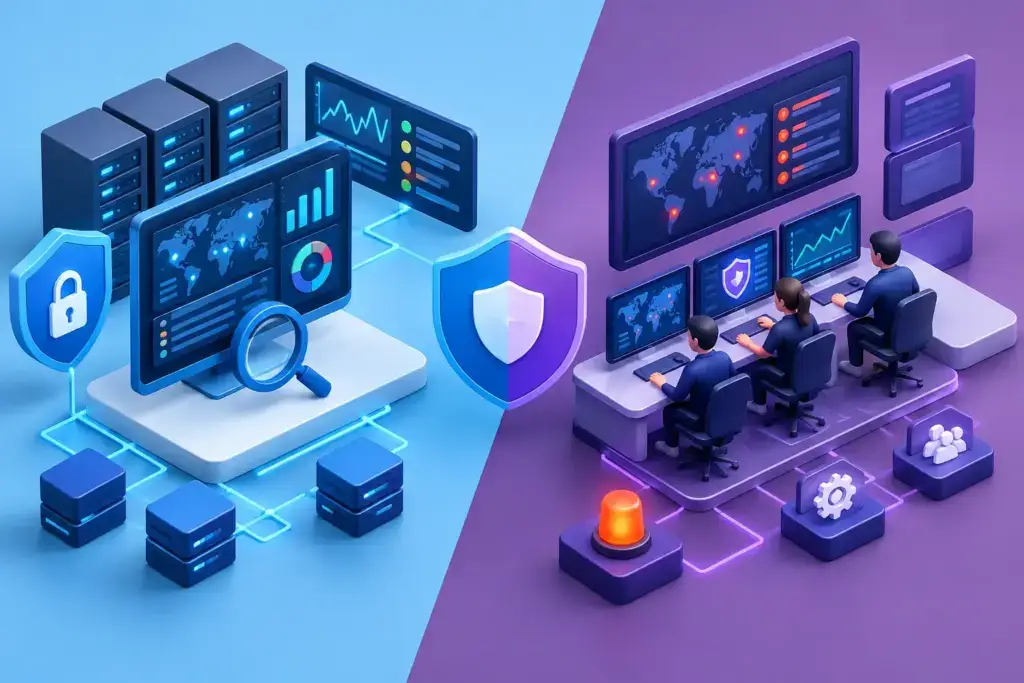
A suspicious sign-in at 2:13 a.m. is not a cybersecurity strategy test your business wants to fail. The practical question behind SIEM versus SOC is simple: do you have technology collecting warning signs, or do you have qualified people who can recognize an actual threat and respond before it spreads?
For small and mid-sized businesses, the distinction matters because security tools can create a false sense of coverage. Buying a platform may improve visibility, but visibility alone does not investigate an alert, disable a compromised account, or tell leadership whether an incident affects operations, compliance, or cyber insurance obligations.
SIEM Versus SOC: The Core Difference
A Security Information and Event Management system, or SIEM, is a technology platform. It collects and centralizes security logs from systems such as firewalls, endpoints, cloud applications, servers, identity platforms, and Microsoft 365. It then correlates events to identify patterns that may indicate suspicious behavior.
A Security Operations Center, or SOC, is the security function responsible for monitoring, investigating, and responding to those signals. A SOC includes people, documented processes, threat intelligence, escalation procedures, and security technology. It may use a SIEM as one of its primary tools, but a SIEM by itself is not a SOC.
Think of the SIEM as the security control room’s dashboard. It gathers information from across the environment and highlights activity that deserves attention. The SOC is the trained team behind that dashboard, deciding whether an alert is harmless, urgent, or part of a broader attack.
That difference is often overlooked when a business evaluates security products. A company can spend significantly on logging and alerting technology yet still have no one consistently reviewing the information or making decisions outside business hours.
What a SIEM Does Well
A well-configured SIEM gives an organization a single place to search and analyze events from many systems. That is especially valuable when a business has grown beyond a simple office network and now relies on cloud software, remote employees, mobile devices, multiple locations, and third-party vendors.
SIEM platforms can help businesses detect unusual patterns, such as repeated failed logins, sign-ins from unexpected locations, a user accessing large amounts of sensitive data, or endpoint activity associated with malware. They also retain records that can support incident investigations, audit requests, and compliance reporting.
For organizations subject to regulatory expectations or contractual security requirements, centralized logging is often a meaningful part of a more mature security posture. It helps answer difficult questions after an event: What happened? Which accounts were involved? How long did activity continue? Was sensitive information accessed?
But the quality of the result depends heavily on configuration. A SIEM must be connected to the right data sources, tuned to the business environment, and maintained as systems change. If it is poorly configured, it may generate an overwhelming volume of low-value alerts. If it is not monitored, meaningful alerts can sit unnoticed.
What a SOC Actually Provides
A SOC turns security data into action. Analysts monitor alerts, validate whether activity is malicious, investigate related evidence, and follow an established response process. Depending on the service model and the severity of the event, that may include isolating a device, disabling a user account, blocking a malicious connection, or escalating to your internal leaders.
The operational value is not simply that someone is watching a screen. A capable SOC reduces the time between detection and response. In many incidents, that time matters more than the initial alert itself. A compromised account can be used to send convincing phishing messages, access files, alter payment instructions, or create additional accounts within minutes or hours.
A SOC also brings consistency. Instead of asking an office manager, internal administrator, or business owner to determine whether an alert is serious, the team works from defined playbooks. They know what evidence to collect, when to escalate, and how to document actions taken.
For a growing business without a full internal cybersecurity department, a managed SOC can provide specialized coverage without the cost and complexity of hiring analysts for around-the-clock shifts. The service still needs to be clearly defined, however. Not every provider monitors the same systems, responds at the same speed, or has authority to take containment actions without waiting for approval.
Why a SIEM Alone Can Fall Short
A SIEM is powerful, but it is not automatically useful. It can produce thousands of events in a day, most of them routine. Separating normal business activity from a real security concern requires context: which users have privileged access, what applications are business-critical, whether a login pattern is expected, and what changes occurred recently.
This is where alert fatigue becomes expensive. Teams that receive too many alerts often begin ignoring them, delaying investigation, or treating every warning as equally urgent. The result is a security program that looks active on paper but provides little practical protection.
There is also a staffing reality. Running a SIEM well requires technical skill in log management, detection engineering, incident response, cloud security, and threat analysis. A small internal IT team may be excellent at supporting users, maintaining systems, and delivering projects, yet still lack the capacity to operate a 24/7 security monitoring function.
That does not mean every business needs an enterprise-scale SIEM deployment. It means security decisions should be based on operational ownership. Before purchasing a platform, ask who will review alerts, how often they will do it, what they can investigate, and who has authority to respond.
Choosing the Right Model for Your Business
The best answer depends on your environment, risk profile, and internal resources. A smaller organization with limited systems may need strong endpoint protection, identity security, backup controls, email protection, and a managed detection and response service before it needs a complex standalone SIEM.
A business with compliance obligations, multiple sites, a distributed workforce, sensitive customer data, or a larger cloud footprint may benefit from centralized SIEM capabilities alongside a managed SOC. The SIEM supplies broad visibility and records; the SOC supplies analysis and response.
Some organizations maintain an internal IT team but use an external SOC to extend coverage. Others use a managed security provider for both the technology and the operating model. Neither approach is inherently better. The right fit is the one with clear responsibility, measurable response expectations, and no uncertainty about what happens when a credible threat is detected.
When comparing providers or platforms, get direct answers to a few operational questions. Is monitoring performed 24/7 or only during business hours? Which systems feed into the monitoring service? Are alerts reviewed by people, automation, or both? Can the provider contain a threat immediately? How are incidents communicated to your leadership team? What reporting shows trends, gaps, and progress over time?
Those answers matter more than a long feature list.
Build Security Around Response, Not Just Alerts
The strongest security programs connect monitoring to the rest of the business. That means identity controls, endpoint protection, email security, patching, backup and recovery, employee awareness, incident response planning, and executive oversight all work together. A SOC cannot compensate for every weak password, unpatched system, or unclear approval process. It can, however, identify and contain threats that bypass preventive controls.
It also helps to define what a security incident means for your business before one occurs. Who needs to be notified? Which systems must be restored first? What information may need to be preserved? When should legal, insurance, or compliance contacts be involved? Clear answers reduce confusion during an already stressful event.
For business leaders, the goal is not to collect more cybersecurity acronyms. It is to create accountable coverage that protects productivity, customer trust, and future growth. Quantum Shield IT approaches that conversation by connecting the tools, monitoring, and leadership process into one practical security plan.
A useful next step is to look at your last meaningful security alert and ask one question: if the same event happened tonight, who would investigate it, who would act, and how quickly would you know? The answer will tell you far more about your readiness than the name of any platform.
