
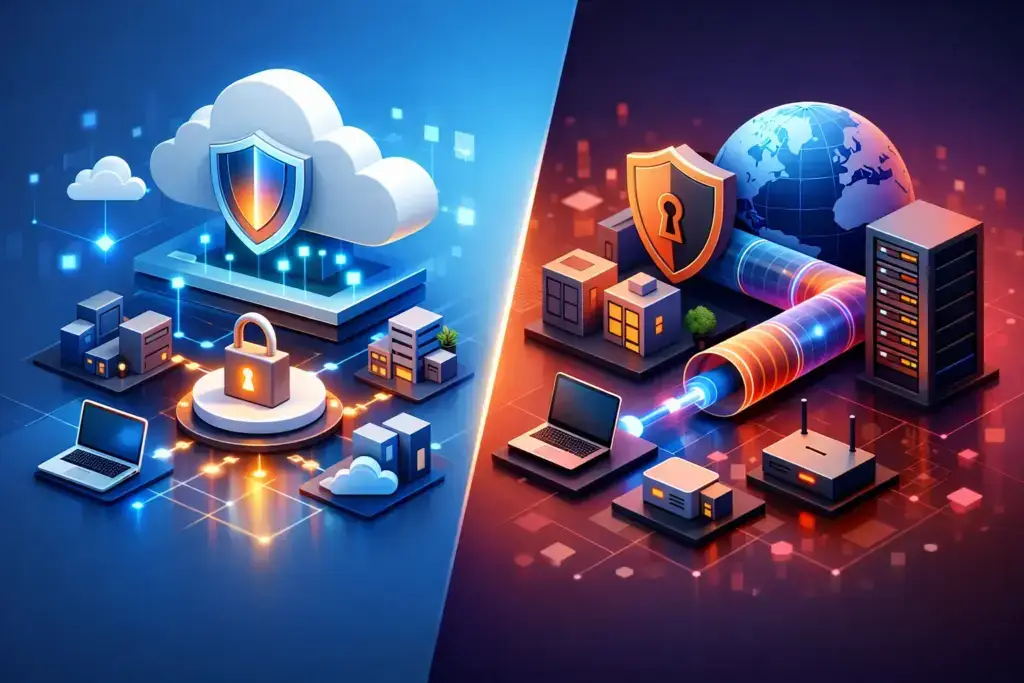
A remote employee needs access to a finance application. A vendor needs to upload files. A branch office needs a dependable connection to cloud systems. The SASE versus VPN decision is not really about choosing a security acronym. It is about deciding how your business will control access as people, applications, and data move beyond one office network.
For many small and mid-sized businesses, a VPN has been the default answer for remote work. It can still be the right answer in specific situations. But when hybrid work, cloud applications, compliance expectations, and cyber insurance requirements begin to stack up, the limitations become harder to ignore. The right approach depends on your users, your systems, your risk tolerance, and the level of oversight your business can realistically maintain.
SASE versus VPN starts with how work happens
A traditional VPN creates an encrypted connection between a user or device and your company network. Once connected, the user can often reach a broad range of internal resources, depending on how the VPN is configured. This made sense when most critical systems lived in a server room and employees primarily worked from a known office or home location.
That model is under pressure. Many businesses now run Microsoft 365, cloud accounting platforms, customer relationship management systems, phone platforms, and line-of-business applications outside the office. Employees work from homes, client sites, warehouses, and public networks. Third parties may need temporary access without becoming full network users.
SASE, short for Secure Access Service Edge, takes a different approach. Rather than treating the network as the center of security, SASE applies security controls closer to the user, device, and application. It is designed to verify who is requesting access, assess whether the device is trustworthy, and grant only the access needed for that specific task.
The distinction matters because an employee who needs one cloud application does not necessarily need a path into the broader company network.
Where VPNs still make sense
VPNs are not obsolete. A well-managed VPN can be practical for a smaller team that needs secure access to a limited number of internal resources, especially when those systems cannot easily be modernized. It is familiar, comparatively simple to deploy, and often included with existing firewall infrastructure.
A VPN can also work well for a narrow use case, such as an IT administrator securely connecting to an on-premises server or a small group accessing a legacy application. When access requirements are predictable and the environment is tightly controlled, it may be the most sensible investment.
The issue is not that VPN technology is inherently insecure. The issue is that VPNs can become difficult to manage safely as exceptions accumulate. A remote employee needs more access. A contractor needs a shortcut. A new branch needs connectivity. An old application requires a workaround. Over time, the VPN can become a broad door into the environment rather than a carefully governed access method.
The common VPN trade-offs
VPN access often relies heavily on the strength of a username, password, and multi-factor authentication prompt. Those controls matter, but they do not always account for device health, user behavior, or whether a person should have access to every resource they can technically reach.
Performance can also suffer. In a traditional setup, cloud traffic may be sent back through the company firewall before reaching the cloud application. That routing can add delay and create a frustrating experience for remote staff. The business impact is rarely labeled as a VPN problem. It shows up as slow systems, help desk tickets, workarounds, and employees using unsanctioned tools to get their jobs done.
What SASE changes
SASE combines networking and security functions delivered through cloud-based points of presence. The exact capabilities vary by provider, but the model commonly includes secure web filtering, firewall controls, zero trust network access, cloud application controls, data protection features, and centralized visibility.
The practical benefit is more precise access. Instead of connecting a user to the network and then trusting them to navigate within it, SASE can connect that user directly to the approved application or service. Access can be based on identity, multi-factor authentication, device status, location, risk signals, and business policy.
For example, a payroll manager on a company-managed laptop may be allowed to reach the payroll platform. The same account attempting access from an unmanaged device in an unusual location may face additional verification or be blocked. A vendor may receive access to one portal without being able to scan, browse, or connect to other company systems.
This is often described as zero trust, but the term can feel abstract. The operational idea is straightforward: do not grant more access than the task requires, and do not assume access should remain valid simply because it was approved once.
SASE versus VPN: the business comparison
The first comparison is scope. VPNs usually focus on creating a secure tunnel into a private network. SASE is built to secure access to both private applications and cloud services. If most of your workforce lives in cloud applications, sending all traffic through a central office network can be inefficient.
The second comparison is visibility. A VPN may show that a user connected successfully, but it may provide limited context about what they did afterward. A well-designed SASE environment can give your IT and security team stronger insight into application use, risky destinations, device compliance, and policy violations. Visibility does not eliminate risk, but it makes informed response possible.
Third is segmentation. With a VPN, reducing access often requires careful network segmentation, firewall rules, and ongoing exception management. SASE can make application-level access easier to define and adjust. That can reduce lateral movement if an account or device is compromised.
Finally, there is operational complexity. SASE simplifies some parts of access management, but it is not a set-it-and-forget-it purchase. Policies must be designed around real job roles. Identity systems must be configured correctly. Device management, endpoint protection, and multi-factor authentication still matter. A poorly planned SASE deployment can create confusion just as easily as an overly broad VPN.
Which model fits your business?
A VPN may be sufficient if your team is small, most work happens inside a controlled office environment, remote access is limited, and your key systems remain on-premises. In that case, the priority should be securing the VPN with multi-factor authentication, least-privilege permissions, patching, logging, and active monitoring.
SASE deserves serious consideration when remote and hybrid work is permanent, cloud applications are central to operations, employees use multiple locations and devices, or compliance pressure is increasing. It is also a strong fit for businesses that need to provide controlled access to contractors, acquired teams, branch offices, or distributed field staff.
The decision should not be driven by fear of missing out on a new security category. Start with the access problems your business is actually experiencing. Are users complaining about performance? Can you confidently explain who has access to sensitive applications? Do former employees, vendors, and temporary workers get removed promptly? Can you see whether unmanaged devices are connecting to company data?
If the answers are unclear, the gap may be less about VPN versus SASE and more about the absence of an access strategy.
Plan the transition before replacing anything
Moving toward SASE does not require an overnight replacement of every firewall, VPN, or network process. For many organizations, the best path is phased. Begin by documenting applications, user groups, devices, current remote-access methods, and data sensitivity. Identify the highest-risk use cases first, such as administrative access, finance systems, remote contractors, or users handling regulated data.
Next, establish the foundations that make either model safer: a reliable identity platform, multi-factor authentication, endpoint management, endpoint detection and response, and defined offboarding procedures. SASE works best when it is part of a coordinated security program rather than a standalone tool purchased to solve every problem.
Test policy changes with a small user group before broad rollout. Measure application performance, support requests, and whether users can complete their actual work without creating workarounds. The goal is not maximum restriction. It is dependable access with controls that match the value and sensitivity of the resource.
For businesses in Las Vegas and Southern California with growing remote teams, this planning is especially valuable. Expansion should not force leaders to choose between employee productivity and sensible security.
A clear access strategy gives leadership something more useful than another technology purchase: confidence that growth will not quietly widen the attack surface. Quantum Shield IT helps businesses turn that confidence into practical priorities, accountable ownership, and a technology roadmap that can keep pace with the way their teams work.
