
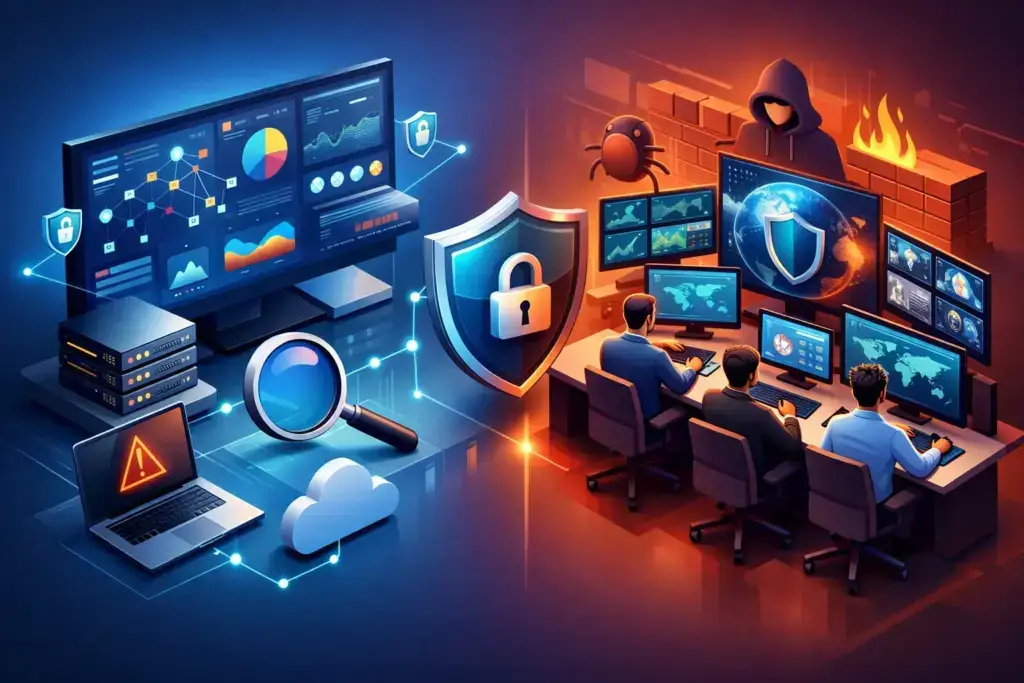
A security alert at 2:13 a.m. does not protect a business. Someone has to recognize whether it is harmless noise, a compromised account, or the first sign of ransomware – then take the right action quickly. That distinction sits at the center of SIEM versus SOC monitoring. One provides technology to collect and analyze security data; the other provides the people, process, and response discipline to turn that data into protection.
For small and mid-sized businesses, the terms are often treated as interchangeable. They are not. Understanding the difference helps leadership avoid a common and costly mistake: buying a security tool and assuming they have built a security operation.
SIEM versus SOC monitoring: the core difference
A Security Information and Event Management platform, or SIEM, gathers logs and security events from across the environment. It may ingest activity from firewalls, endpoints, Microsoft 365, identity systems, servers, cloud applications, and network devices. The platform correlates that information to identify suspicious patterns, such as an employee account logging in from two impossible locations or a server suddenly transferring an unusual volume of data.
A Security Operations Center, or SOC, is the capability that monitors, investigates, and responds to those signals. A SOC can be an internal team, an outsourced managed service, or a hybrid model. Its analysts use a SIEM and other tools, but the SOC is not the tool itself. It is the operating function responsible for deciding what an alert means and what happens next.
Think of a SIEM as the security control room’s information system. It can collect camera feeds, alarm signals, and door-access records. SOC monitoring is the trained team watching those systems, separating real danger from routine activity, calling the right people, and taking action under a defined plan.
What a SIEM does well
A well-configured SIEM creates visibility that most growing businesses cannot achieve through individual dashboards. Instead of asking an administrator to check a firewall console, endpoint portal, and cloud tenant separately, the SIEM brings relevant evidence together. That centralization is particularly useful when an organization needs stronger reporting for cyber insurance, regulatory obligations, customer requirements, or executive oversight.
SIEM tools also retain log data for investigation. If a business discovers that an account was compromised three weeks ago, historical logs can help determine when the activity began, which systems were accessed, and whether data may have been exposed. That evidence matters when leadership needs facts, not assumptions.
However, a SIEM is only as useful as its configuration, integrations, and tuning. Poorly configured collection leaves blind spots. Untuned rules generate a flood of alerts. And even a properly deployed platform cannot contain an attack by itself unless it is connected to response automation and managed by people who understand the environment.
For many businesses, the hidden challenge is not obtaining a SIEM license. It is maintaining the platform as systems change, reviewing alert logic, keeping integrations healthy, and ensuring someone is accountable for incidents after business hours.
What SOC monitoring adds
SOC monitoring adds judgment, continuity, and response. Analysts review alerts in context: the user involved, the device’s history, the sensitivity of the system, known attack patterns, and normal activity for that business. This matters because not every suspicious event is malicious, but every event ignored without review is a risk.
A capable SOC typically validates alerts, investigates potential threats, escalates confirmed incidents, and follows documented response procedures. Depending on the service model and authorized access, the team may isolate a device, disable a risky account session, block malicious indicators, or coordinate with the client’s IT team to contain the issue.
The value is not simply that someone is watching a screen 24/7. The value is having an accountable process when a threat appears. Who gets contacted? How quickly? What actions are authorized? What evidence is preserved? How will the business recover if an account, endpoint, or server is affected? Those details determine whether security monitoring reduces disruption or merely produces another email in an already crowded inbox.
SOC monitoring also benefits from familiarity with the business. A login from another state may be normal for a traveling executive and suspicious for a payroll coordinator who never works remotely. The better the team understands the environment, user roles, critical systems, and operational priorities, the more accurately it can investigate and respond.
Why a SIEM alone is rarely enough
Businesses often purchase a SIEM after an audit finding, a cyber insurance questionnaire, or a troubling incident. The investment may satisfy a technical requirement, but it does not automatically create continuous monitoring. Logs can be collected while alerts go unreviewed. High-priority detections can sit in a queue because the internal administrator is managing users, printers, line-of-business applications, and daily support requests.
This is not a criticism of internal IT teams. It is a capacity issue. Security investigation requires a different rhythm than operational support. An administrator who is expected to keep employees productive during the day cannot realistically be available around the clock to triage security telemetry, research emerging threats, and respond within a meaningful window.
There is also an alert-fatigue problem. Security tools can produce hundreds or thousands of events. Without tuning and trained analysis, teams begin to dismiss alerts because most appear benign. Attackers benefit from that noise. They do not need every alert to be missed – only the one that matters.
When an internal SOC makes sense
An internal SOC can be appropriate for larger organizations with sensitive environments, substantial compliance requirements, or a mature internal security staff. It offers direct control over staffing, procedures, and business knowledge. But it requires more than assigning security responsibility to one IT employee.
A true internal operation needs enough coverage to handle absences and after-hours events, defined escalation paths, tested incident response procedures, management oversight, and ongoing investment in training and tools. For many organizations in the 10-to-450-employee range, building that capability internally is difficult to justify financially.
A hybrid approach can work well. Internal leaders retain ownership of business decisions and strategic priorities, while an external SOC provides continuous monitoring, specialized analysis, and incident support. This arrangement is especially practical when the business has an internal administrator who knows the environment but lacks the time or team depth for 24/7 security operations.
How to evaluate a managed SOC service
Do not stop at the phrase “24/7 monitoring.” Ask what happens after an alert is detected. The answer should be specific and operational, not vague.
Clarify whether the provider monitors endpoints, identities, email, firewalls, cloud services, and network activity, or only a limited set of sources. Ask how alerts are triaged, which events trigger immediate escalation, and whether analysts can take containment actions. Confirm the escalation process, expected response times, communication channels, and whether the service includes incident remediation or only notification.
It is equally important to understand ownership. Your business should retain access to relevant security data, documentation, and reporting. Leadership needs regular visibility into trends, unresolved risks, security improvements, and priorities for the next quarter. Monitoring without clear reporting can become another black-box vendor relationship.
At Quantum Shield IT, the objective is not to add another isolated security product to a client’s stack. It is to connect monitoring, operational IT, identity protection, backup readiness, compliance needs, and executive planning into a security program that supports the business.
Choose the capability, not just the label
The best answer to SIEM versus SOC monitoring is usually not either-or. A SIEM can provide valuable data and detection capability. A SOC provides the human oversight and response process that makes those signals actionable. Some managed SOC services include a SIEM-like platform; others integrate with tools the business already owns.
The right model depends on your risk profile, systems, staffing, compliance obligations, and tolerance for downtime. A professional services firm protecting client data may prioritize identity and email monitoring. A multi-location business may need deeper network visibility. A company handling regulated information may require longer log retention and more formal incident documentation.
Start with a practical question: if a credible account takeover or ransomware alert appears tonight, who will investigate it, who can act, and how will your business know the response is working? A clear answer is the foundation of security monitoring that earns its place in the budget.
