
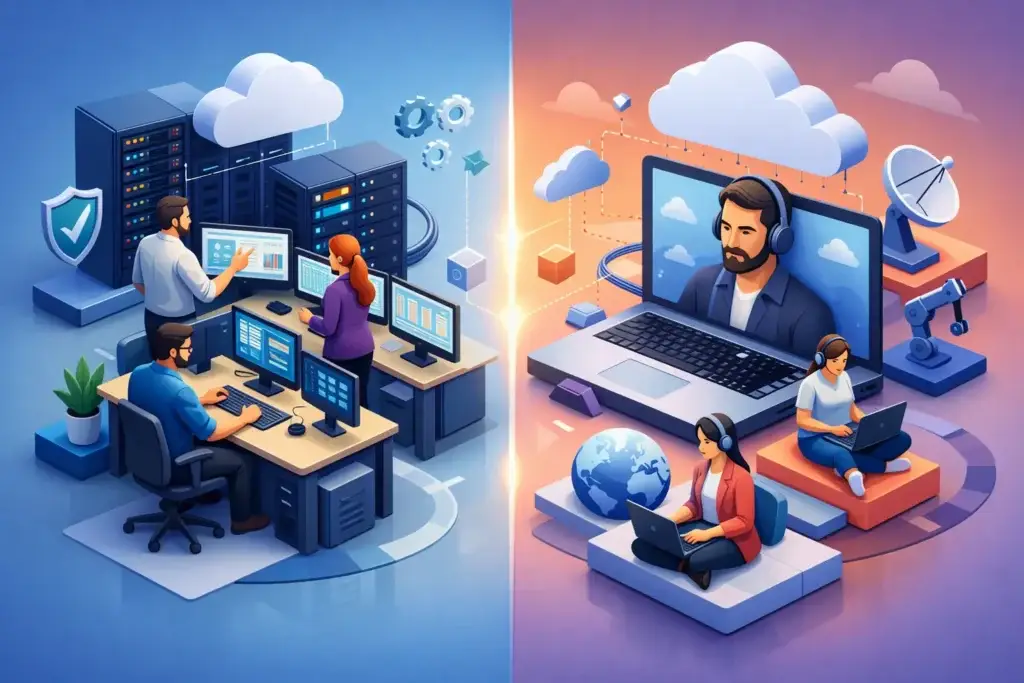
A server outage at 8:15 a.m., a suspicious payroll email, and a new office opening should not force your operations leader to become the de facto IT department. Yet that is exactly how many growing businesses end up making technology decisions: under pressure, with incomplete visibility, and after a problem has already disrupted work.
The in house IT vs outsourcing decision is not simply about whether to hire people or sign a service agreement. It determines how quickly your business can respond to issues, how consistently you manage cyber risk, and whether technology supports growth or repeatedly gets in its way. For most small and mid-sized organizations, the strongest answer is not purely one model or the other. It is the model that gives leadership clear accountability, the right expertise, and predictable coverage.
Why this decision gets harder as a business grows
Early on, IT is often handled by a capable employee, a local break-fix technician, or a small internal team doing its best to keep systems running. That arrangement can work while the company has a simple network, a limited number of users, and few formal compliance requirements.
Growth changes the equation. More employees mean more devices, identities, access permissions, software subscriptions, and opportunities for error. Hybrid work expands the security perimeter. Clients, insurers, and regulators may ask tougher questions about backups, multifactor authentication, incident response, and documented controls. At that point, IT is no longer just a support function. It is an operational and business risk function.
The wrong decision is not necessarily choosing internal IT or outsourced IT. The wrong decision is assuming the existing approach will scale because it has not failed visibly yet.
In house IT vs outsourcing: what each model really provides
An in-house IT model means employing technology staff directly. That might be one IT manager, a help desk team, a systems administrator, or a larger department. Outsourcing means engaging an external provider to deliver some or all IT functions, often through a managed services agreement.
Neither model is automatically more mature. A well-led internal team can be highly effective. A poorly scoped outsourced relationship can leave gaps. The difference comes down to coverage, capability, accountability, and alignment with the business.
The case for an in-house team
Internal IT offers proximity. Your team knows the people, processes, applications, and day-to-day friction points inside the business. They can walk the floor, support a critical meeting, coordinate directly with department leaders, and build institutional knowledge over time.
For organizations with complex proprietary systems, specialized equipment, around-the-clock operations, or hundreds of employees, that context can be especially valuable. An internal leader can also become a strong voice in strategic planning when they have the authority and business perspective to do more than manage tickets.
The trade-off is breadth. One capable IT manager cannot also be a cybersecurity analyst, cloud architect, compliance specialist, network engineer, backup expert, VoIP administrator, and vCIO. Even a small internal team can face a coverage problem during vacations, turnover, major projects, or a security incident that demands immediate specialized attention.
Hiring also carries costs beyond salary. Benefits, recruiting, training, certifications, management time, tools, and turnover all affect the real investment. Businesses sometimes compare a managed services fee with one employee’s salary and miss the larger cost of building a dependable technology function.
The case for outsourced IT
Outsourced IT gives a business access to a broader bench of specialists without requiring multiple full-time hires. A mature managed service provider can provide help desk support, monitoring, patching, endpoint protection, backup oversight, cloud administration, vendor management, strategic planning, and security guidance through one accountable relationship.
This model can be particularly effective for companies that need mature capabilities but do not need, or cannot justify, a full internal department. It replaces the uncertainty of reactive support with defined processes, scheduled maintenance, documented standards, and a clearer view of technology spending.
Outsourcing is not a license to disengage. The provider still needs a decision-maker on the client side who can set business priorities, approve changes, and communicate operational needs. The best relationships feel less like handing off a problem and more like adding an experienced technology team to the business.
The risk is choosing a provider that operates only as a ticket queue. If the relationship centers on closing support requests but never addresses security posture, lifecycle planning, vendor sprawl, or future growth, the business may receive support without receiving direction.
Compare the factors that matter to leadership
Cost matters, but it should not be the only lens. A lower monthly figure has little value if recurring downtime, weak security controls, or surprise project costs continue to drain the business. Leaders should compare operating models across the outcomes they need, not just the line items they can see.
Control and responsiveness are often cited in favor of internal IT. That can be true, especially when employees need frequent onsite assistance. But responsiveness should be measured by service levels, escalation paths, and actual resolution quality, not simply physical presence. A local outsourced partner with a defined support process may be more responsive than a single overloaded internal employee.
Security depth is another major dividing line. Cybersecurity requires ongoing monitoring, identity controls, endpoint protection, vulnerability management, employee awareness, backup testing, and a practiced response plan. Many businesses do not need a full-time in-house security operations center, but they do need more than antivirus software and good intentions.
Strategic visibility is just as important. Your technology plan should answer practical questions: Which systems are nearing end of life? What will the next office or acquisition require? Where are the largest cyber risks? Which projects will improve productivity? Who owns each decision? Without this roadmap, IT spending becomes a series of expensive reactions.
Scalability favors whichever model can add capability before the business reaches a breaking point. If you are hiring rapidly, opening locations, moving to Microsoft 365, supporting remote staff, or preparing for compliance reviews, you need a team that can absorb change without putting routine support on hold.
When a hybrid model is the better answer
For many organizations, the practical answer is a hybrid model. An internal IT manager or administrator remains close to the business while an MSP and managed security provider supplies specialized expertise, tools, coverage, and executive-level guidance.
This structure can work well when internal staff understand line-of-business applications, facilities, or user needs but lack time to manage cybersecurity and infrastructure at a deeper level. It also protects the company from relying too heavily on one person. The internal resource gains backup, escalation support, and a path to execute larger projects without carrying every responsibility alone.
A hybrid arrangement only works when responsibilities are explicit. Who owns help desk tickets? Who manages Microsoft 365? Who approves access? Who monitors threats after hours? Who tests backups? Who leads the roadmap? Ambiguity creates the same vendor-sprawl problem that a hybrid model is meant to solve.
Questions to ask before choosing an IT model
Before hiring or outsourcing, leadership should assess the business honestly. Start with the current pain points: recurring outages, unresolved tickets, poor documentation, inconsistent onboarding, weak backup confidence, or concerns about phishing and ransomware. Then look ahead 12 to 24 months. Growth plans should shape the technology model before they create new risk.
Ask whether your current team has the capacity and expertise to cover daily support, security, cloud administration, infrastructure planning, vendor coordination, and emergency response. Ask what happens when a key employee is unavailable. Ask whether leadership receives regular reporting in business terms, not just a list of completed tickets.
If you evaluate a provider, look beyond the proposal price. Request clarity on what is included, what is excluded, how cybersecurity is handled, how escalations work, how often strategy is reviewed, and who will know your environment. A provider should be able to explain priorities plainly and identify gaps without using fear as a sales tactic.
Build the model around accountability, not convenience
A dependable IT function has a named owner, documented standards, measurable service expectations, and a plan for the next stage of the business. Whether that function is built internally, externally, or through a hybrid approach, leadership should know who is responsible when something goes wrong and who is helping prevent the next issue.
For growing businesses in Las Vegas and Southern California, that level of clarity can turn technology from a recurring source of stress into a more predictable part of operations. Quantum Shield IT approaches managed IT and cybersecurity with that same principle: one strategic relationship, clear priorities, and a roadmap connected to the way the business intends to grow.
Choose the model that gives your people support today and gives your leadership confidence about tomorrow. The best IT decision is the one that leaves fewer surprises, stronger defenses, and more room for the business to move forward.
