
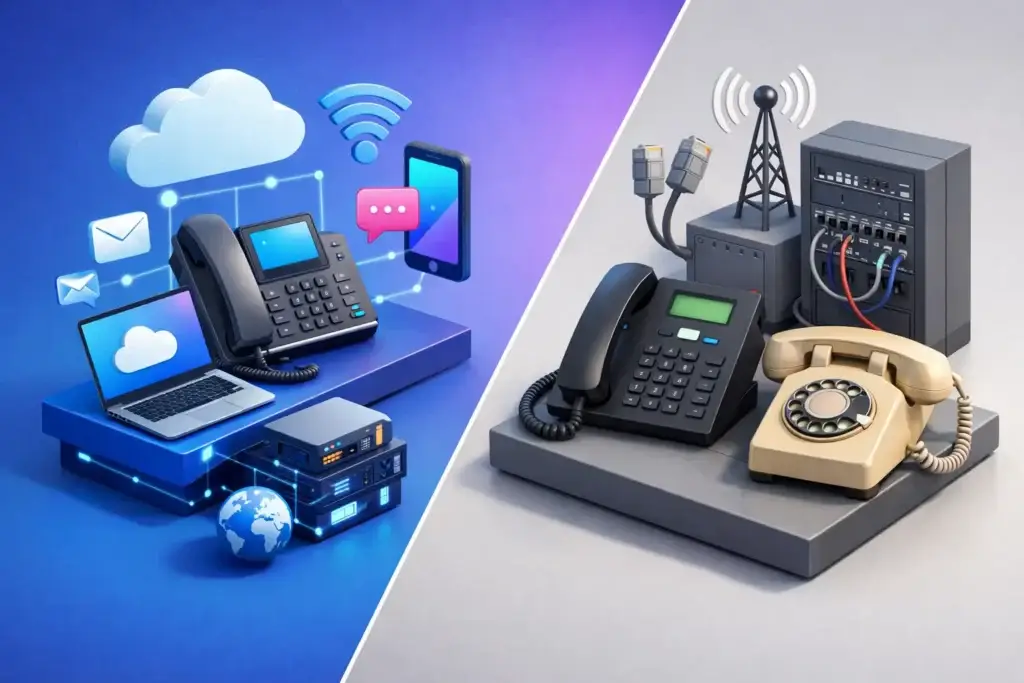
If your phone system still feels like a utility bill you pay without thinking about, it may be costing more than the monthly invoice suggests. For growing companies, the real VoIP vs traditional phone systems decision usually comes down to something bigger than dial tone. It affects flexibility, security, staffing, customer experience, and how easily your business can adapt when work no longer happens at a single front desk.
For many small and mid-sized businesses, the old phone model stayed in place because it worked well enough. A desk phone rang, calls came in, and nobody wanted to touch a critical system. That logic made sense for a long time. But once teams became mobile, offices spread across locations, and customer response times started depending on shared visibility, the limits of traditional systems became harder to ignore.
VoIP vs traditional phone systems: what changes in practice?
Traditional phone systems rely on physical phone lines and on-premises hardware tied closely to a building. In many cases, that setup includes PBX equipment, carrier contracts, and service changes that require a technician or at least specialized support. It is familiar, and in some environments, that familiarity still matters.
VoIP, or Voice over Internet Protocol, routes calls over your internet connection rather than conventional phone lines. That basic shift changes how the system is managed and how your team uses it. A business number can ring on a desk phone, laptop, or mobile app. Adding a user may take minutes instead of a service call. Call routing, voicemail, recordings, and analytics tend to be easier to access and manage.
The difference is not only technical. It is operational. Traditional systems are often built around a location. VoIP is built around users, devices, and workflows.
Cost is rarely as simple as the monthly line item
A lot of decision-makers start with cost, and that is reasonable. On paper, traditional systems can look stable if the hardware is already paid for. If your team has used the same setup for years, changing it can feel like introducing cost where none existed before.
But that view usually leaves out maintenance, replacement parts, carrier limitations, expansion costs, and the time your staff spends working around old features. When a traditional system needs changes, you may be paying for slow support, specialty vendors, or hardware that is becoming harder to source. Those expenses do not always show up in one line item, but they are still real.
VoIP generally shifts phone service into a more predictable operating expense. That can lower upfront hardware costs and make growth easier to budget. If you hire ten people, open another office, or support remote staff, you are not rebuilding the whole phone environment. You are extending an existing system.
That said, VoIP is not automatically cheaper in every situation. If your internet connectivity is weak, inconsistent, or poorly managed, you may need network upgrades to get the performance you want. For businesses with very simple calling needs and little change over time, a legacy system can still be financially acceptable. The right question is not just Which costs less today? It is Which model creates fewer constraints over the next three to five years?
Reliability depends on the environment behind the phones
One of the biggest arguments in favor of traditional systems has always been reliability. If the internet goes down, old-style phone lines may continue to function. For some businesses, especially those with critical inbound call volume or life-safety considerations, that is not a small point.
But reliability is no longer a one-variable issue. Many traditional systems rely on aging infrastructure, limited vendor support, and hardware that becomes a problem the moment something fails. A stable phone line does not help much if the system around it is difficult to maintain or impossible to scale.
With VoIP, call quality and uptime depend heavily on network design. A well-managed network with proper bandwidth, quality of service settings, backup internet options, and battery backup can make VoIP highly dependable. A poorly managed network will create dropped calls, latency, and frustration.
This is where business leaders often get bad advice. They are told VoIP is unreliable when the real issue is unmanaged infrastructure. Phones are only as good as the network carrying them. If your business already relies on cloud apps, Microsoft 365, video meetings, and distributed access, treating the network as strategic infrastructure makes sense regardless of your phone decision.
The backup question matters more than the sales pitch
Every phone system should be evaluated based on failure scenarios. What happens if your office loses power? What happens if your internet provider has an outage? What happens if a key employee needs to take calls from home without warning?
VoIP often performs better than people expect in these scenarios because calls can be rerouted quickly to mobile devices or alternate locations. Traditional systems may keep local calling alive in some outages, but they are often less flexible when the building itself becomes the problem.
Security is part of the VoIP vs traditional phone systems conversation
Phone systems used to sit outside the main security discussion. That is no longer realistic. Voice platforms contain user accounts, call data, voicemail, auto attendants, mobile apps, and administrative access. They are part of your business systems, not separate from them.
Traditional phone systems are sometimes viewed as safer simply because they are older and less connected. That assumption can create blind spots. Unsupported PBX hardware, weak admin credentials, and neglected carrier integrations can all introduce risk. A legacy system is not automatically secure because it is familiar.
VoIP introduces different considerations. Because it connects through your network and often through cloud administration portals, it needs the same discipline as the rest of your environment. Access controls, MFA, user provisioning, network segmentation, monitoring, and vendor oversight all matter. If your business has compliance requirements or cyber insurance expectations, those controls become even more important.
For most organizations, the best answer is not to avoid modern communications. It is to manage them like business-critical infrastructure. A phone platform should be part of your broader IT and security plan, not an orphaned system handled only when something breaks.
Flexibility is where VoIP usually pulls ahead
Business growth creates complexity fast. New hires need numbers and extensions. Departments need call routing. Leadership wants reporting. Remote employees need the same experience as in-office staff. Customers expect faster response and fewer handoffs.
This is where VoIP tends to create a clear advantage. It supports hybrid work without turning every exception into a workaround. Staff can make and receive calls from multiple devices while keeping business numbers separate from personal ones. Admin teams can update routing, holiday schedules, voicemail, and call groups without waiting days for a provider.
Traditional systems can still handle core calling needs, but they often struggle when the organization changes shape. If your company is growing, hiring across multiple locations, or standardizing operations, flexibility becomes more than a convenience. It becomes part of service delivery.
Customer experience is part of infrastructure now
Most leaders do not think about the phone system until customers complain. Calls go to the wrong place, voicemails are missed, transfers fail, or nobody knows who answered what. Those are not minor annoyances. They affect revenue and trust.
VoIP platforms usually offer better visibility into call flows, queue performance, recordings, and missed call patterns. That gives operations leaders something they rarely get from older systems: usable data. If you can see where calls are failing, you can fix the process behind them.
When traditional phone systems still make sense
Not every business should rush to replace a traditional setup. If you operate in a location with poor internet options, have a highly stable workforce with minimal feature needs, or depend on niche analog devices that have not been addressed in a transition plan, keeping part of a legacy environment may be reasonable.
There are also cases where a phased approach is smarter than a full cutover. Some organizations keep specific lines or devices while moving the broader business to VoIP. That can reduce disruption and give teams time to adapt.
The mistake is not choosing traditional phone service. The mistake is keeping it by default, without testing whether it still supports the business you are actually running.
How to make the right call for your business
The best VoIP vs traditional phone systems decision starts with a business review, not a product demo. Look at how your team works today, what frustrates staff, where calls break down, and what growth will require over the next few years.
If your company values mobility, easier administration, better reporting, and simpler scaling, VoIP is usually the stronger fit. If your environment has infrastructure gaps, those need to be addressed honestly so the phone system is not blamed for deeper network issues.
If you are not sure where the friction really is, that is often the signal that the phone system should be evaluated as part of a larger IT and security roadmap. At Quantum Shield IT, that broader view tends to produce better outcomes because communications, infrastructure, and cybersecurity are assessed together instead of in separate conversations.
A phone system should make your business easier to run, not harder to maintain. The right choice is the one that gives your team confidence on a normal Tuesday and options when things do not go according to plan.
