
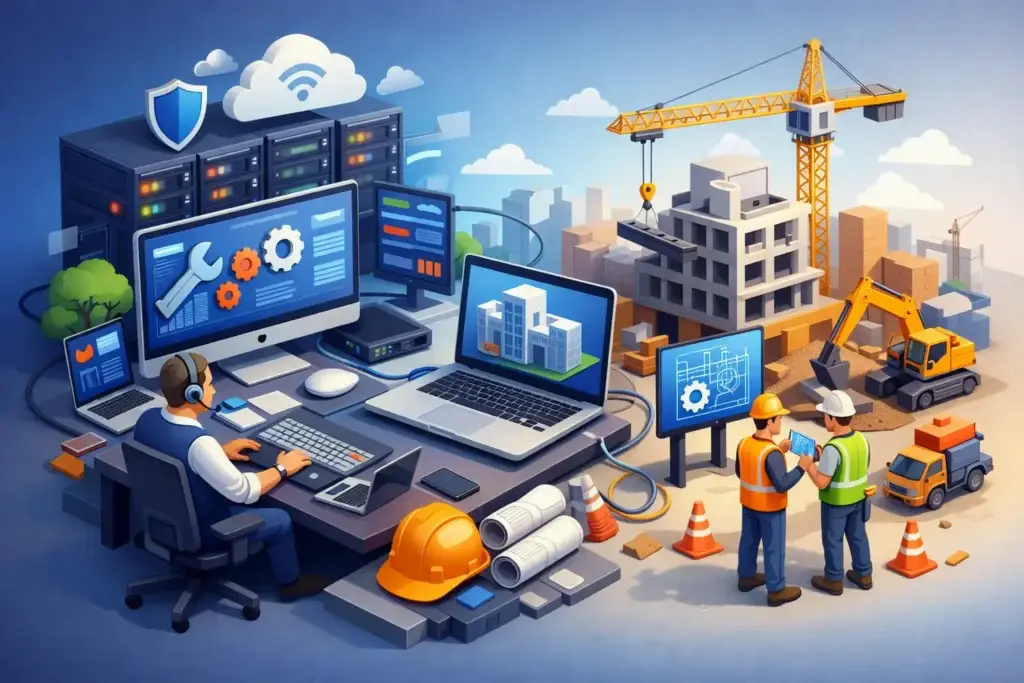
A superintendent is waiting on revised plans, the project manager cannot open the file from the trailer, and accounting is calling about a payment app that stopped syncing. That is what IT support for construction companies looks like in real life. It is not just about fixing laptops. It is about keeping jobs moving when teams are spread across trailers, sites, warehouses, vehicles, and the office.
Construction puts unusual pressure on technology. Your team works in changing environments, often with weak connectivity, tight deadlines, multiple subcontractors, and a constant flow of documents, photos, approvals, and financial data. If your IT setup was built for a standard office, it usually starts breaking down as the business grows.
Why IT support for construction companies is different
A law firm or accounting office can usually operate inside one controlled environment. Construction companies do not have that luxury. Their workforce is mobile, their timelines are unforgiving, and many critical decisions happen away from a desk.
That changes what good support looks like. You need more than a help desk that responds when someone submits a ticket. You need systems that work across job sites, cloud platforms that do not create version confusion, security controls that protect field devices, and a plan for when internet service at a trailer goes down at the worst possible time.
There is also a people factor. In construction, technology only helps if it fits how crews, project managers, estimators, and back-office teams actually work. A complicated system that looks good on paper but slows down field adoption will create workarounds. Those workarounds become risk.
The real cost of reactive support
A lot of construction companies start with a patchwork model. One vendor handles phones, another manages cameras, a freelance technician helps with computers, and someone internally becomes the default person for every software issue. That can hold together for a while. Then the company adds projects, hires more people, and the cracks start showing.
Reactive support is expensive in ways that do not always show up on an invoice. Downtime delays decisions. Poor device management creates lost hours in the field. Bad backups turn small mistakes into major recovery events. Security gaps raise the odds of ransomware, wire fraud, or cyber insurance problems.
The bigger issue is operational drag. When technology is unreliable, your leadership team spends time chasing vendors, resolving preventable issues, and making decisions without clear visibility. That is time pulled away from production, margins, and growth.
What construction companies actually need from IT
The right model is not the same for every contractor. A specialty subcontractor with 25 employees has different needs than a multi-location general contractor with 200 users. Still, the core requirements tend to be consistent.
First, field connectivity has to be treated as a business priority. That includes stable internet at trailers, backup connectivity options, secure remote access, and support for mobile devices and tablets. If teams cannot get to the systems they need from where they work, productivity suffers immediately.
Second, document control matters more than many companies realize. Construction runs on drawings, revisions, RFIs, submittals, schedules, and photos. When file access is disorganized, people make decisions from outdated information. Good IT support helps structure Microsoft 365, cloud storage, permissions, and backup policies so teams can find the right version quickly and securely.
Third, device management needs to be proactive. Field laptops, tablets, phones, printers, and office workstations all need updates, monitoring, security controls, and replacement planning. Construction environments are hard on hardware. Dust, weather, travel, and job site movement shorten device life and increase support demands.
Fourth, cybersecurity cannot be separated from daily IT anymore. Construction firms are frequent targets because they move money, manage vendor relationships, and often rely on email-based approvals. A phishing email to accounting or a compromised project manager account can create real financial damage. Basic antivirus is not enough.
Where many construction IT setups break down
The most common problems are usually not dramatic. They are persistent.
Internet at a site trailer is unstable, so teams hotspot their phones and move files around manually. Shared folders become cluttered, and nobody is sure which file is final. New hires wait too long for devices and access. Former employees keep active accounts longer than they should. Multifactor authentication is inconsistent. Backups exist, but nobody has tested a restore. Leadership assumes someone is handling strategy, but support is mostly ticket-based and reactive.
None of these issues look catastrophic on their own. Together, they create an environment where work slows down, risk increases, and planning gets pushed aside.
This is where a more mature support model earns its value. Not because it promises perfection, but because it reduces the number of preventable surprises.
What strong IT support for construction companies should include
At a practical level, support should cover the basics well. That means user help, device setup, patching, monitoring, vendor coordination, and issue resolution. But for construction, that baseline is not enough.
You also need network planning for offices, trailers, and remote teams. You need backup and disaster recovery that account for both cloud data and critical local systems. You need security monitoring, email protection, access control, and a clear process for onboarding and offboarding users. If you rely on Microsoft 365, someone should be actively managing it, not just licensing it.
The best providers also bring executive-level planning. That includes budgeting for refresh cycles, standardizing hardware, reducing software sprawl, aligning security controls with insurance and compliance needs, and building a roadmap around how the company actually plans to grow.
That strategic layer is often what construction companies have been missing. They do not need more technical noise. They need a partner who can say, clearly, what needs to happen now, what can wait, and what risks are worth addressing before they become expensive.
Security and business continuity matter on every job
Construction leaders sometimes think cybersecurity is mostly a concern for finance or healthcare. In reality, construction companies face a practical set of threats that can disrupt operations fast.
Email compromise is a major one. Billing updates, vendor requests, ACH changes, and executive impersonation attempts are common. Ransomware is another. If project files, accounting systems, or shared drives become unavailable, job operations can stall. Lost or stolen field devices are also a concern, especially when those devices have saved credentials or access to cloud platforms.
Business continuity is just as important as threat prevention. If a trailer network fails, if a server goes down, or if a user deletes the wrong file, how quickly can your team recover? A backup that exists but has never been tested is not much of a plan.
For companies working across Southern California or Las Vegas, weather, travel, and distributed teams can add another layer of complexity. The farther your people are spread out, the more intentional your infrastructure and support process need to be.
How to evaluate an IT partner for a construction business
If you are considering outside support, ask direct questions. Do they understand field operations, not just office support? Can they manage both IT and security, or will you still be coordinating multiple providers? Do they help with planning and standards, or only fix issues after they happen?
You should also ask how they handle onboarding, documentation, backups, cloud administration, and incident response. If the answers are vague, that usually tells you something. A strong partner should be able to explain their process in business terms and give you visibility into priorities.
It also helps to pay attention to what they do not overpromise. No provider can eliminate every outage, every user mistake, or every cyber threat. Good partners are candid about trade-offs. For example, tighter security can add some friction for users, and replacing aging hardware may cost money sooner than you hoped. The point is to make those trade-offs intentionally, not by default.
A company like Quantum Shield IT fits this model when it acts as a strategic technology partner, not just a repair service. For construction firms, that distinction matters.
Growth gets easier when IT stops being a patchwork
Most construction companies do not want more technology for the sake of it. They want fewer delays, fewer security concerns, less vendor confusion, and better control as the business scales.
That usually comes from consolidation and clear ownership. When one team can support users, manage infrastructure, strengthen security, and help leadership plan ahead, the business runs with more confidence. Problems get resolved faster. Standards improve. Decisions become less reactive.
The right IT support for construction companies should make operations feel steadier, not more complicated. If your current environment depends on workarounds, scattered vendors, and crossed fingers, that is not just an IT issue. It is an operational one. Fixing it gives your team a better shot at staying productive under pressure, which is where construction companies do their best work.
