
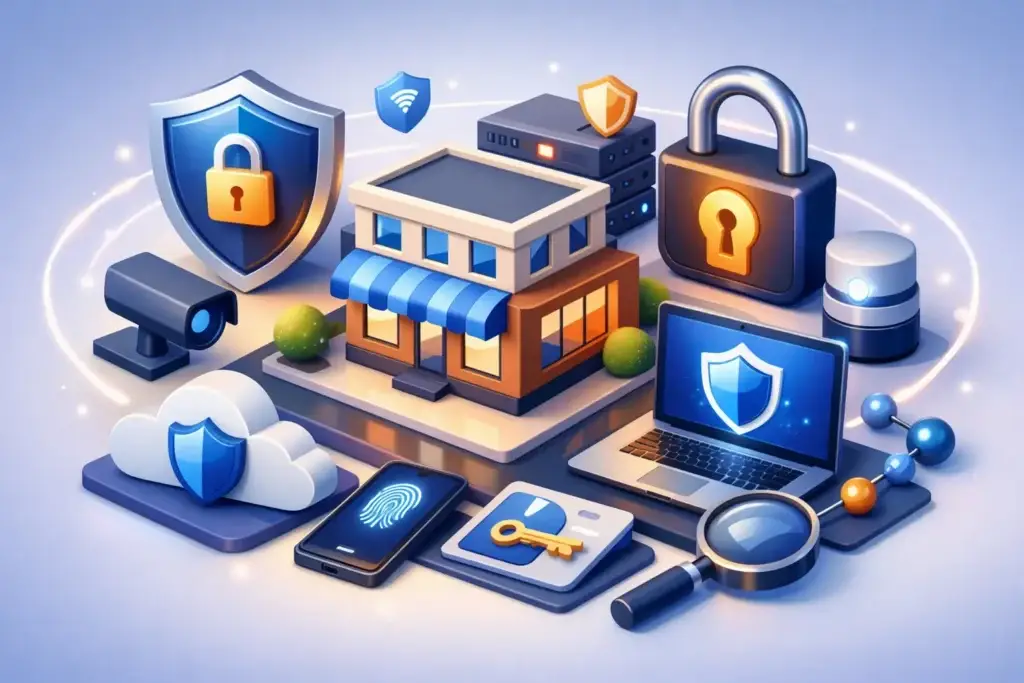
Most small businesses do not have a security problem because they lack tools. They have a security problem because they have the wrong mix of tools, no clear ownership, and too many gaps between vendors. The best small business security stack is not the one with the longest feature list. It is the one that fits how your business actually operates, protects the highest-risk areas first, and stays manageable as you grow.
That matters because most attacks against small and mid-sized organizations are not movie-style breaches. They are password theft, fake invoices, business email compromise, ransomware, exposed cloud data, and missed alerts that sit unresolved for days. If your environment includes Microsoft 365, remote users, mobile devices, shared files, line-of-business apps, and a lean internal team, your security stack needs to be built around visibility, control, and response – not just software licenses.
What the best small business security stack actually includes
A strong stack is layered on purpose. Each layer covers a different kind of risk, and each one should support the others. If one control fails, another should still slow down the attacker or limit damage.
For most small businesses, that starts with identity security. Email and cloud logins are now the front door. If attackers gain access to a user account, they often do not need to break through a firewall at all. That is why multi-factor authentication, conditional access policies, password management, and role-based access matter more than many companies realize. Admin access should be limited to only the people who truly need it, and even then it should be separated from daily user activity.
The next layer is endpoint protection. Laptops, desktops, and servers are where malware executes, files get encrypted, and suspicious behavior often begins. Basic antivirus is no longer enough on its own. Small businesses need modern endpoint detection and response that can identify unusual behavior, isolate compromised devices, and give someone a way to investigate alerts before they turn into downtime.
Email security belongs in its own category because so many real incidents start there. Filtering spam is table stakes. The stronger controls are impersonation protection, malicious link analysis, attachment scanning, and policy settings that reduce the chance of account abuse or spoofed messages. If your staff handles payments, vendor changes, HR data, or contracts, email protection deserves serious attention.
Then there is backup and disaster recovery. This is where many businesses assume they are covered because files sync to the cloud. Sync is not backup. If ransomware encrypts files or a user deletes data, synchronization can spread the damage. A real security stack includes tested backups, retention policies, offsite copies, and a realistic recovery plan for core systems.
Network security still matters, but it has changed. Firewalls remain important, especially for office locations, guest networks, site-to-site connectivity, and traffic inspection. But for hybrid businesses, the network is no longer the whole perimeter. Remote access, cloud applications, and unmanaged home environments mean identity and endpoint controls now carry more weight than they did a decade ago.
The best small business security stack is built around business risk
This is where many buying decisions go sideways. Owners and operations leaders are often shown product demos before anyone defines the actual risk profile of the business.
A 20-person professional services firm has different priorities than a 120-user company with field staff, compliance requirements, and shared customer data across multiple systems. A medical office, law firm, construction company, and e-commerce brand all face different exposure points. The right stack depends on what would hurt the business most if it failed – email compromise, downtime, data leakage, payment fraud, compliance penalties, or loss of customer trust.
That is why a useful security plan starts with a few plain questions. Where is your critical data? Who can access it? Which systems would stop operations if they went down? What is your cyber insurance asking for? What are regulators or clients expecting? And if an alert comes in at 2:00 a.m., who is actually responsible for responding?
When those answers are clear, the stack becomes easier to shape. You stop buying overlapping tools and start investing in controls that close meaningful gaps.
Core layers every small business should consider
Identity and access management should be the anchor. That means multi-factor authentication across all critical systems, strong login policies, limited administrator rights, and regular access reviews. If your business is in Microsoft 365, this is often the fastest place to improve security without disrupting operations.
Managed endpoint detection and response is the second essential layer. The key word is managed. Detection only helps if someone is watching alerts, validating threats, and acting quickly. Many small businesses own security software they are not truly using because no one has time to monitor it.
Security awareness training also deserves a permanent place in the stack. This is not because employees are the problem. It is because attackers target normal behavior – urgency, trust, routine approvals, and simple mistakes. Short, recurring training paired with phishing simulations can reduce avoidable incidents and make users part of the defense strategy.
Vulnerability management is another important piece. Systems, browsers, apps, and firewalls all need updates, and unpatched devices remain one of the easiest ways in. The right stack includes asset visibility, patch management, and a process for dealing with unsupported systems before they become liability magnets.
Logging and monitoring help tie the stack together. If you cannot see what is happening across endpoints, email, firewalls, and cloud accounts, you are relying on luck. Centralized monitoring does not need to be enterprise-heavy, but it does need to provide enough visibility to catch suspicious activity early.
Finally, governance matters more than many small businesses expect. Written policies, incident response plans, basic documentation, and leadership accountability are part of security. They are not paperwork for its own sake. They reduce confusion during real events and make compliance, insurance, and audit conversations much easier.
Where small businesses usually overspend or underinvest
The most common overspend is buying too many tools from too many vendors. A company might have one product for antivirus, another for email filtering, another for backups, another for password management, and no one checking whether those systems integrate or whether alerts are being reviewed. That creates complexity without necessarily improving protection.
The most common underinvestment is response capability. Prevention matters, but no tool stack prevents every incident. Small businesses need a clear plan for what happens when something slips through. That may mean a managed security team, a trusted IT and security partner, or a defined internal escalation path. What matters is that someone owns the outcome.
Another underinvestment is strategy. Security stacks often grow reactively – one tool after a phishing scare, another after an insurance questionnaire, another after a vendor recommendation. Over time, the environment becomes expensive, fragmented, and difficult to manage. A better approach is to map the stack to business priorities and review it on a schedule, not only after a problem.
How to choose a stack without creating vendor sprawl
Start with consolidation where it makes sense. Fewer platforms can mean better visibility, simpler support, and less finger-pointing when something goes wrong. That does not mean every solution should come from one manufacturer. It means your environment should be designed as a system, not a pile of subscriptions.
Look closely at operational fit. Can your team actually manage the tools? Are policies realistic for your users? Will the solution support hybrid work, mobile devices, and future growth? The strongest stack on paper can still fail if it creates too much friction or depends on skills your business does not have.
This is also where a partner model becomes valuable. Many small and mid-sized businesses do not need to hire a full internal security team, but they do need guidance that connects technical controls to business decisions. A provider such as Quantum Shield IT can help unify IT operations, security monitoring, cloud controls, backups, compliance support, and executive planning so the stack works as one program rather than a collection of point fixes.
A better goal than “fully secure”
No small business becomes fully secure. That is not a realistic target, and chasing it usually leads to waste. A better goal is to become materially harder to compromise, faster to detect issues, and more prepared to recover if something goes wrong.
That is what the best small business security stack should do. It should reduce avoidable risk, support insurance and compliance expectations, protect productivity, and give leadership fewer surprises. If your current setup feels scattered, the answer is not always more tools. Often it is a clearer strategy, tighter layers, and one accountable plan.
The smartest security stack is the one your business can actually run with confidence next quarter, next year, and through the next stage of growth.
