
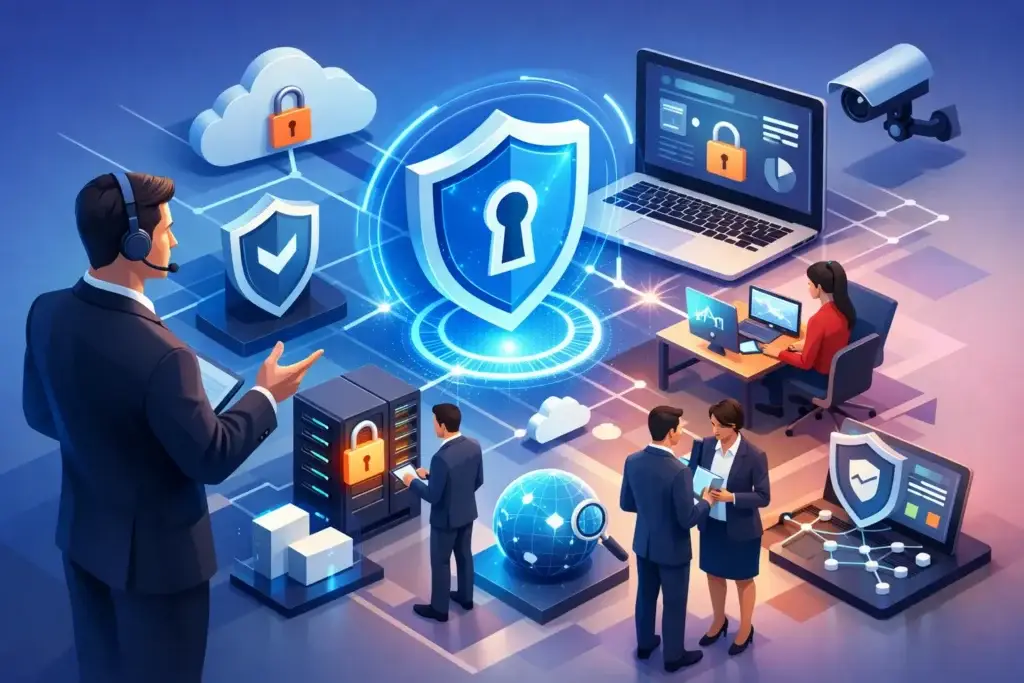
If your company has firewalls, antivirus, cyber insurance forms, compliance pressure, and a growing list of security tools – but no clear owner of the bigger picture – you are already feeling the gap a vCISO is meant to fill. When business leaders ask what does a vCISO do, the short answer is this: a virtual Chief Information Security Officer gives you security leadership without the cost and overhead of a full-time executive.
That matters most for small and mid-sized businesses that have outgrown basic IT support but are not ready to hire a six-figure security executive. A vCISO does not replace your IT team or your managed security tools. They give those efforts direction, priority, and accountability.
What does a vCISO do in practical terms?
A vCISO translates cybersecurity from a technical problem into a business function. Instead of treating security as a stack of disconnected products, they look at how risk affects operations, revenue, compliance, customer trust, and insurability.
In practice, that means a vCISO reviews your current security posture, identifies your biggest exposures, and helps leadership decide what actually needs attention first. Not every company needs the same controls at the same time. A healthcare practice, a construction firm, and a professional services company can all face meaningful cyber risk, but the priorities will differ based on systems, data, regulatory obligations, and internal resources.
A good vCISO also becomes the person who can answer executive questions clearly. Are we exposed? Are we meeting basic security standards? What would happen if ransomware hit us tomorrow? What do we need for cyber insurance renewal? Which investments reduce risk versus just adding cost? Those are leadership questions, not help desk questions.
The core responsibilities of a vCISO
The role usually starts with risk assessment and planning. A vCISO looks at your environment, policies, vendors, cloud systems, user practices, backup strategy, access controls, endpoint protection, and incident readiness. The goal is not to generate a thick report that sits in a folder. The goal is to create a realistic roadmap.
That roadmap is one of the most valuable parts of the role. Many businesses know they need better cybersecurity, but they do not know what “better” means for their size or risk profile. A vCISO creates a prioritized plan that ties security improvements to business reality. If cash flow is tight, the plan may phase improvements over time. If the company is pursuing a contract that requires compliance, the roadmap may focus first on the controls needed to qualify.
Policy development is another major area. Most organizations have security expectations floating around informally, but very few have clear, current, enforceable policies. A vCISO helps establish rules for password management, access permissions, device use, remote work, vendor access, incident response, and data handling. This is not paperwork for its own sake. Policies matter because they create consistency, support compliance, and reduce confusion when something goes wrong.
A vCISO also oversees governance. That means making sure security is reviewed regularly, measured over time, and reported to leadership in a way that supports decisions. Governance is where cybersecurity stops being reactive and starts becoming manageable.
What a vCISO does not do
This is where expectations need to be clear. A vCISO is not usually the person resetting passwords, patching workstations, or responding to every day-to-day ticket. They are also not a magic fix for years of neglected infrastructure.
Think of the role as strategic leadership with hands-on oversight, not purely tactical support. Depending on the provider, a vCISO may work closely with the IT team, an MSP, an MSSP, or internal administrators to make sure the plan is executed. But the value comes from judgment, prioritization, and leadership presence.
That distinction matters because many businesses confuse buying security tools with having security leadership. You can have endpoint detection, email filtering, multifactor authentication, and backups in place and still be poorly managed from a security standpoint. Tools are necessary. Leadership is what makes them work together.
Compliance, insurance, and vendor pressure
For many companies, the question is not just what does a vCISO do, but why now. Often, the answer shows up in outside pressure.
Cyber insurance carriers now ask more detailed questions and expect evidence behind your answers. Customers and larger partners increasingly require security questionnaires, contractual controls, or proof of compliance. Depending on your industry, you may also need to align with frameworks or regulations tied to healthcare, finance, legal obligations, or sensitive customer data.
A vCISO helps you prepare for that pressure instead of scrambling every time a questionnaire lands in your inbox. They can map your controls to the expectations you face, identify gaps, and help you fix them in the right order. That reduces surprises and helps leadership speak confidently to insurers, auditors, clients, and board members.
There is a trade-off here. If your company only needs a one-time compliance checklist, a full vCISO engagement may be more than you need. But if compliance, insurance, and client security expectations are now recurring parts of how you do business, having ongoing security leadership usually saves time and lowers risk.
Incident planning and response leadership
One of the clearest signs of vCISO value is what happens before an incident, not during one. Most organizations assume they will “figure it out” if something serious happens. That approach fails fast when systems are encrypted, employees are locked out, customers are waiting, and leadership needs answers immediately.
A vCISO helps build and refine an incident response plan so the business is not improvising under pressure. That includes defining roles, escalation paths, outside contacts, communication expectations, and recovery priorities. If an incident does occur, the vCISO often helps coordinate the response from a leadership standpoint, making sure technical action aligns with business impact.
This does not mean they personally perform every forensic or remediation task. It means they help command the situation, manage decision-making, and keep leadership focused on what matters most.
A vCISO brings accountability to security spending
Small and mid-sized businesses often spend money on cybersecurity in fragments. They buy one tool after a scare, another after an insurance requirement, and another because a vendor made a strong pitch. Over time, that creates overlap, gaps, and budget fatigue.
A vCISO helps bring discipline to that process. They can evaluate whether your current investments match your actual risk, whether your controls are working, and whether the next dollar should go toward training, monitoring, backup resilience, identity protection, policy work, or network improvements.
That is especially useful for companies trying to scale. Security maturity is not about collecting software. It is about making deliberate decisions as the business grows, hires, adds locations, supports remote teams, or moves more operations into cloud platforms.
When a business should consider a vCISO
You do not need to wait for a breach to justify this role. In fact, that is usually the most expensive time to realize you needed one.
A vCISO makes sense when your company is growing faster than your security processes, when leadership keeps getting pulled into cyber decisions without enough visibility, or when compliance and insurance questions are becoming harder to answer. It also makes sense when you have solid technical support in place but no one owning the larger security strategy.
For businesses in markets like Southern California and Las Vegas, where growth, distributed workforces, and vendor complexity often move faster than internal security maturity, this kind of leadership can be the difference between staying ahead and constantly reacting.
What to expect from a strong vCISO relationship
The best vCISO relationships are not built around fear. They are built around clarity. You should expect regular reporting, practical recommendations, honest prioritization, and communication that leadership can actually use.
You should also expect nuance. Not every risk can be eliminated. Not every framework needs to be adopted in full. Not every security control belongs in the current quarter. A capable vCISO helps you make smart decisions based on business context, not generic best-practice pressure.
That is where the role becomes more than outsourced advice. It becomes part of how the business plans, protects, and grows. For companies that want fewer surprises, stronger accountability, and a security strategy that matches their actual operations, that is usually the real answer to what does a vCISO do.
The right vCISO gives you a steady hand at the leadership level, so security stops feeling like a scattered set of problems and starts functioning like a managed part of the business.
