
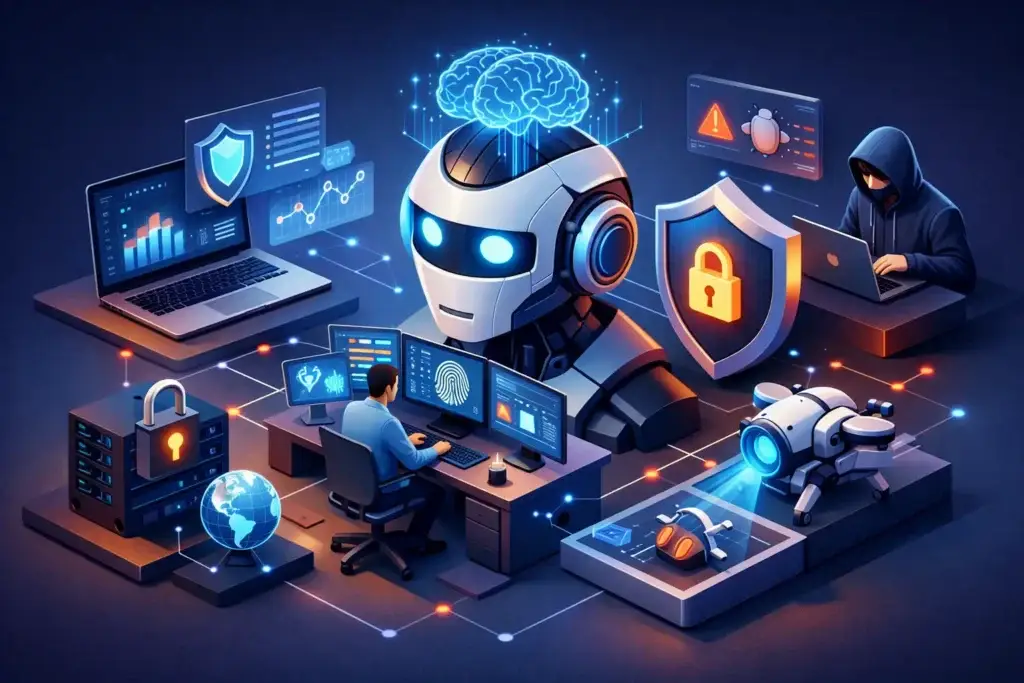
At 2:13 a.m., an account signs in from a new location, pulls a large batch of files, and triggers a string of failed admin actions. In a lot of small and mid-sized businesses, no one sees that chain of events until the next morning – if they see it at all. That gap is exactly why AI in cybersecurity operations has moved from a nice idea to a practical business discussion.
For companies without a deep in-house security bench, the appeal is obvious. Security teams are flooded with alerts, attackers move quickly, and routine review work eats up time that should be spent on reducing risk. AI can help sort, correlate, and prioritize what matters. It can also create false confidence if leaders assume it replaces process, oversight, or experienced judgment. The real value is not magic. It is speed, context, and better use of limited resources.
What AI in cybersecurity operations actually does
The simplest way to think about it is this: AI helps security teams process more signals than humans can review on their own. Modern environments generate logs and alerts from endpoints, firewalls, cloud apps, email platforms, identity systems, and collaboration tools. Most of that data is not actionable by itself. AI models can connect those events, spot patterns, and surface activity that deserves immediate attention.
In practice, that often means detecting unusual login behavior, identifying suspicious privilege changes, recognizing signs of phishing, or grouping related alerts into a single incident. Instead of handing an analyst 300 disconnected notifications, a platform may present one higher-confidence story: this user clicked a malicious link, their device executed a payload, and the attacker then attempted lateral movement.
That matters because security operations are not just about detection. They are about triage, decision-making, and response timing. If AI reduces noise and sharpens context, teams can act faster without expanding headcount at the same pace as risk.
Where AI improves cybersecurity operations first
The first gains usually show up in repetitive work. Alert enrichment is a good example. Analysts often have to gather the same context repeatedly – user details, device history, geolocation, asset criticality, recent activity, and known indicators. AI can automate much of that collection and package it in a usable way.
Threat detection is another strong use case. Rules and signatures still matter, but they are limited to what has already been defined. AI-based analytics can identify behavior that looks abnormal even when there is no exact signature match. That does not make traditional controls obsolete. It means detection becomes less dependent on static conditions alone.
Response support is improving as well. In many environments, AI helps trigger preapproved actions such as isolating an endpoint, disabling a compromised account, or escalating an incident based on confidence thresholds. That kind of automation is valuable when every minute matters, especially for businesses that do not staff a 24/7 internal security team.
The biggest win is focus
For most SMBs, the most immediate operational benefit is not a futuristic defense system. It is focus. AI can help teams spend less time chasing harmless alerts and more time addressing real risk, policy gaps, weak controls, and user behavior issues that keep leading to trouble.
The limits of AI in cybersecurity operations
This is where a lot of marketing gets ahead of reality. AI is useful, but it is not self-managing security.
First, AI systems are only as effective as the data, configuration, and oversight behind them. Poorly tuned tools can flood teams with bad alerts or miss meaningful threats. If your identity controls are weak, your endpoint coverage is inconsistent, or critical logs are not flowing into the right systems, AI has less to work with.
Second, attackers use AI too. They are getting better at writing convincing phishing messages, automating reconnaissance, and testing variations at scale. That means AI does not create a one-sided advantage. It raises the speed and sophistication of both defense and offense.
Third, AI can make the wrong call. It may misclassify activity, over-prioritize odd but harmless behavior, or under-prioritize subtle compromise. High-quality security operations still need human review, documented playbooks, and escalation paths. For regulated businesses or companies with cyber insurance requirements, that oversight is not optional.
Why human judgment still matters
Context changes everything. A login from another state may be suspicious for one employee and expected for another. A surge in file activity may signal exfiltration or a legitimate migration project. AI can flag anomalies, but it cannot fully understand business intent without structured inputs and accountable review.
That is why the strongest security programs use AI to support analysts, not replace them. The tool should accelerate good decision-making, not become the decision-maker by default.
How SMBs should evaluate AI in cybersecurity operations
Most business leaders do not need a lesson in model architecture. They need to know whether a solution will reduce risk, fit their environment, and improve operational clarity.
Start with the problem, not the product. Are you trying to reduce alert fatigue? Improve after-hours monitoring? Tighten incident response? Strengthen email security? Support compliance reporting? Different AI-enabled platforms solve different problems, and many overlap only partly.
Then look at your operational readiness. AI performs better when the basics are in place: managed endpoints, centralized logging, identity security, multifactor authentication, documented response steps, and clear ownership. If those pieces are missing, the smartest platform in the world will not create mature operations on its own.
It also helps to ask direct questions about how decisions are made. What actions are automated? What confidence threshold triggers escalation? Who reviews incidents? How are false positives measured? How often is the environment tuned? Business leaders should expect plain answers, not vague promises.
Common mistakes companies make
One common mistake is buying an AI-enabled security tool and assuming the project is finished. Tools need onboarding, integration, tuning, and routine review. Without that work, leaders end up paying for features they do not actually use.
Another mistake is treating AI as a substitute for strategy. Security operations only work when they align with business priorities. A manufacturer, medical office, law firm, and construction company will not all face the same exposure or tolerate the same response actions. Good operations are calibrated to the business, not just the technology stack.
A third mistake is spreading responsibilities across too many vendors. If one provider manages IT, another handles email filtering, another monitors alerts, and no one owns the full picture, AI insights often stall in handoffs. That is one reason many growing businesses move toward a more integrated MSP and MSSP relationship. The fewer blind spots between infrastructure, identity, endpoints, and response, the more useful the intelligence becomes.
What good looks like over the next 12 months
For most SMBs, success with AI in cybersecurity operations will look pretty practical. Fewer meaningless alerts. Faster investigation times. Better visibility into identity risk. More consistent response after hours. Cleaner reporting for leadership, insurance, and compliance conversations.
It may also look quieter. Fewer surprises. Fewer moments where an owner or operations leader has to guess whether an event is serious. That reduction in uncertainty matters just as much as the technology itself.
Companies in fast-moving markets like Southern California and Las Vegas often feel this pressure early because growth, hybrid work, vendor sprawl, and compliance demands tend to collide at the same time. The organizations that handle it best are usually not the ones chasing the newest tool first. They are the ones building a security operation that can actually absorb and use those tools well.
AI is becoming part of the standard security stack, but the business question is still the same: does it help your team make better decisions, faster, with less risk and less confusion? If the answer is yes, it is worth pursuing. If the answer is maybe, the next step is usually not more software. It is better structure, clearer ownership, and a security partner that can turn the technology into a working operation.
The smartest move is rarely to ask whether AI belongs in your security program. It is to ask where it can remove friction, improve visibility, and support the people accountable for protecting the business every day.
